
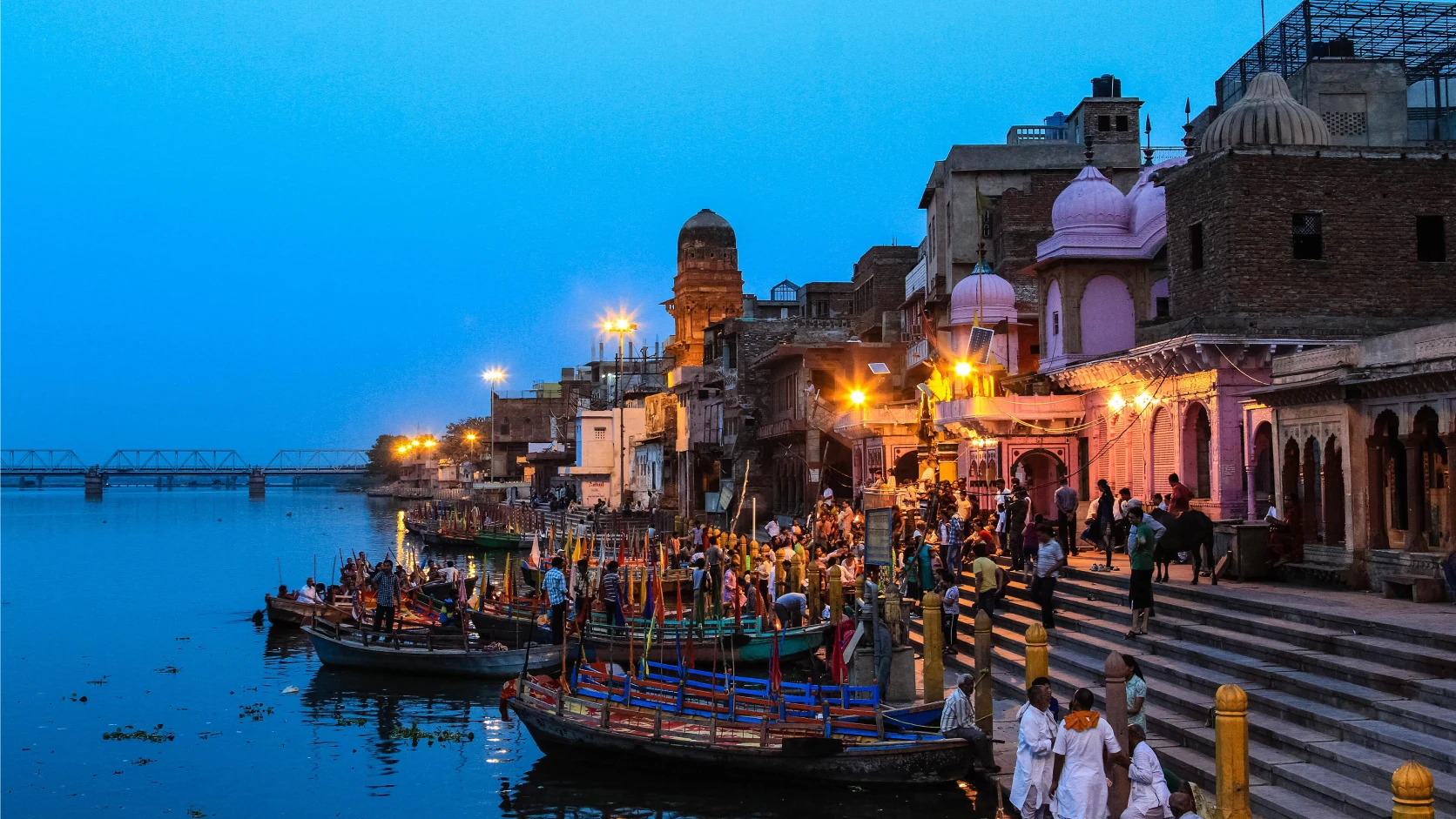
Shri Yamuna Ji is the eternal companion of Shrimati Radharani. Outside Braj Dham, she is widely revered as a sacred river and worshipped as a divine goddess. The Puranas describe her as the sister of Yamaraj, the ruler of Yampuri. She is also known as Kalindi Nandini, the daughter of Surya Dev, and is described as a wife of Dwarkadhish Shri Krishna and a queen of Dwarka.
But in Braj Dham, the Rasik saints reveal a deeper and more intimate identity of Shri Yamuna Ji. They describe her as Rasrani Shri Yamuna, the eternal companion of Shri Radha and Krishna. Her heart knows only one purpose—to lovingly serve Shri Radha-Krishna and assist in Their eternal divine leelas.
श्री यमुना जी श्रीमति राधारानी की नित्य सहचरी हैं। ब्रज धाम के बाहर, यमुना जी को एक पवित्र नदी के रूप में माना जाता है और लोग उनकी पूजा करते हैं, पुराण उन्हें यमपुरी के राजा यम की बहन के रूप में वर्णित करते हैं। पुराण में यमुना जी के बारे में यह भी वर्णन है जैसे कि कालिंदी नंदिनी, सूर्य देव की पुत्री, द्वारिकाधीश श्री कृष्ण की पत्नी, द्वारिका की रानी। परन्तु ब्रज धाम में रसिक वर्णन करते हैं की श्री यमुना रसरानी श्री राधा कृष्ण नित्य सहचरी हैं, जो केवल श्री राधा कृष्ण की सेवा करना जानती हैं।
🔴 Watch LIVE Shri Yamuna Ji Aarti Daily
Stand beside Yamuna Ji in Vrindavan early in the morning, and the town feels different.
The sun is still soft. Temple bells ring somewhere behind the narrow lanes. A few boats move across the dark water. Devotees arrive carrying flowers. Someone quietly chants “Radhe Radhe.” Another person sits on the steps of a ghat with closed eyes, doing nothing that looks remarkable.
Yet, for many devotees, this simple moment carries centuries of memory.
Yamuna Ji is one of the most sacred rivers of India, but her place in Braj has a character of its own. Here, she is remembered as a divine presence closely connected with Shri Krishna and His leelas. Vrindavan, Mathura, Gokul and the wider Braj region grew beside stories in which Yamuna Ji appears again and again.
This is why visiting the Yamuna in Vrindavan can feel quite different from visiting a river as a tourist.
You’re standing beside a living part of Braj’s sacred geography.
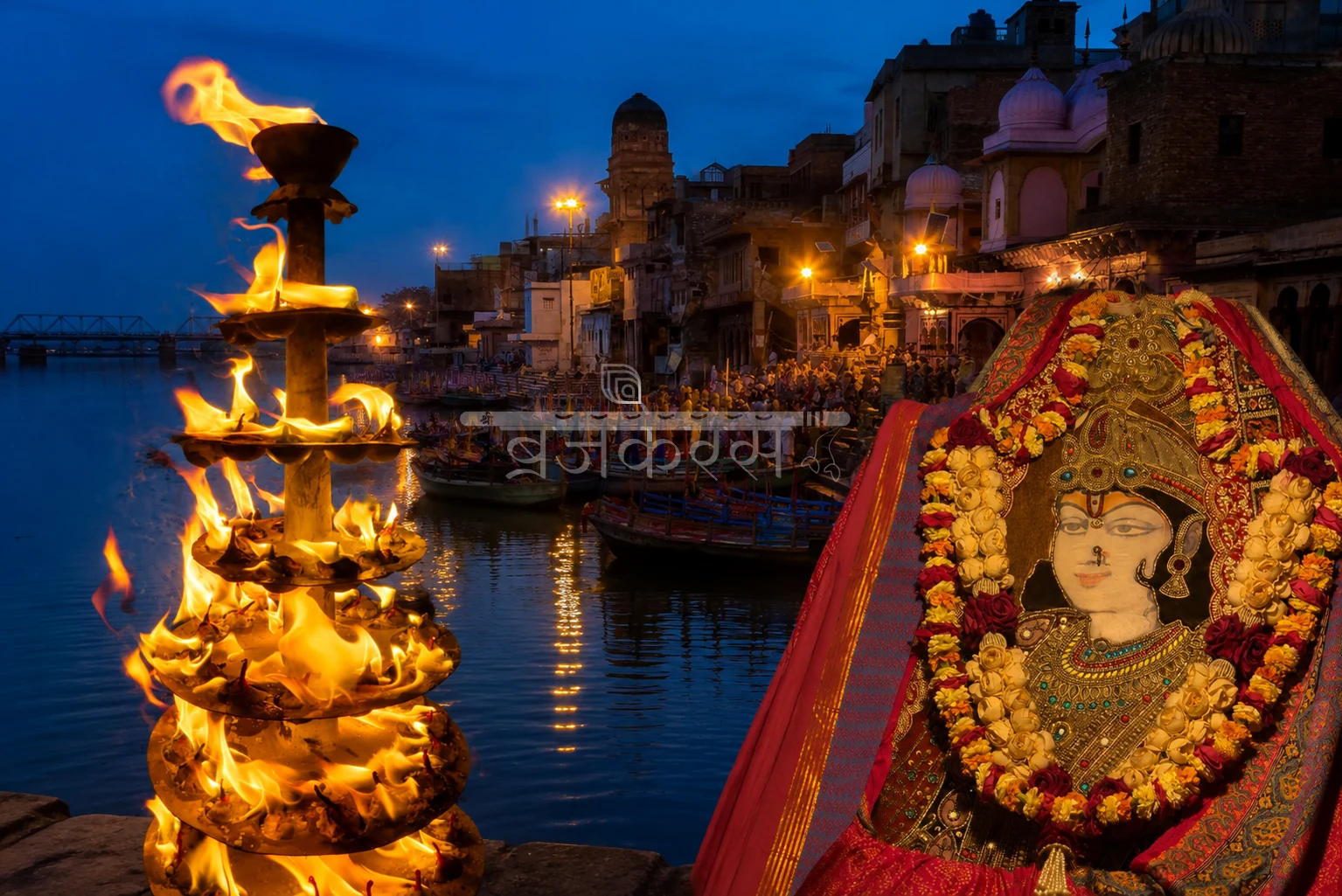
Why Is Yamuna Ji So Sacred?
In Hindu tradition, Yamuna is worshipped as a goddess and is commonly described as the daughter of Surya Dev, the Sun God, and sister of Yama, the deity associated with death and dharma.
Her sacred identity appears across Hindu religious tradition, Puranic narratives and centuries of devotional practice.
Yet Braj gives Yamuna Ji another layer of meaning.
Here, devotees affectionately call her Yamuna Maiya or Shri Yamuna Maharani. She is remembered through Krishna’s childhood leelas, Braj poetry, temple traditions, songs and daily worship.
Her water becomes part of the emotional geography of Krishna bhakti.
Think about Braj without Yamuna Ji for a moment.
Krishna crossing the river as a newborn. His childhood near its banks. Kaliya Nag. The gopis. The ghats of Vrindavan. Centuries of saints singing about Radha and Krishna beside the river.
Remove Yamuna Ji and something fundamental disappears from the picture.
Before Vrindavan Wakes Up, Yamuna Ji Is Already There
Morning is perhaps the loveliest time to meet Yamuna Ji in Vrindavan.
Around sunrise, several ghats begin filling with pilgrims. Priests prepare for worship. Small lamps flicker near the steps. Birds circle above the water, and boats wait along the riverbank.
There’s movement, but it can still feel peaceful.
For someone visiting Braj for the first time, this is a good place to begin.
Don’t rush straight from one famous temple to another.
Spend a little time beside Yamuna Ji.
Braj is often experienced through temples such as Banke Bihari Ji, Radha Raman Ji, Radha Damodar Ji, ISKCON Krishna Balaram Mandir and Prem Mandir. These places naturally attract large numbers of pilgrims.
Yet the Yamuna gives you another view of Vrindavan.
A quieter one.
Sit on a ghat for a few minutes and watch how local life and devotion overlap. Priests perform rituals. Families arrive for darshan. Brajwasis walk past. Pilgrims offer prayers. Boats carry visitors along the river.
Sacred tradition here isn’t kept behind museum glass. It continues as part of daily life.
The Night Shri Krishna Crossed Yamuna Ji
One of the most loved stories connected with Yamuna Ji begins on the night of Shri Krishna’s birth.
Krishna was born to Devaki and Vasudeva in Mathura under the rule of Kansa. Vasudeva was instructed to carry the newborn Krishna across the Yamuna to Gokul, where He would be raised by Nanda Baba and Yashoda Maiya.
It was a dark and stormy night.
Vasudeva carried baby Krishna in a basket and approached the Yamuna. The river was swollen, yet a path opened for him to cross.
Devotional retellings often describe Yamuna Ji rising to touch the feet of baby Krishna before allowing Vasudeva to continue.
It is a tender image.
The river doesn’t appear as scenery. She participates in the leela.
For visitors, knowing stories like this changes how Braj feels. A road between Mathura and Gokul stops being a road on Google Maps. The Yamuna stops being a blue line running through a district.
The places begin speaking to one another.
Mathura is connected with Krishna’s birth. Gokul recalls His earliest childhood. Vrindavan carries countless memories of His later childhood pastimes.
And Yamuna Ji flows through the middle of these memories.
Then Comes the Story of Kaliya Nag
Perhaps no Yamuna leela is visually remembered as strongly as Kaliya Mardan.
According to the Bhagavata Purana, the serpent Kaliya had made his home in a section of the Yamuna. His poison contaminated the water and affected the surrounding area.
Krishna entered the water and confronted him.
After subduing Kaliya, Krishna climbed upon the serpent’s many hoods. Kaliya’s wives prayed for mercy, and Krishna spared him, ordering him to leave the Yamuna.
Artists have painted this scene for centuries: young Krishna standing fearlessly upon the raised hoods of a giant serpent.
It’s dramatic, yes.
Yet the leela carries a deeper devotional image too — disorder is subdued, poisoned water is freed, and fear gives way before Krishna.
Visitors to Vrindavan can connect this episode with Kaliya Ghat, traditionally associated with the Kaliya episode.
Standing there after knowing the story feels different from simply checking another attraction off a list.
That’s one reason Braj rewards slow travel.
The stories matter.
Keshi Ghat: Where Vrindavan Meets Yamuna Ji
If one image captures Yamuna Ji in Vrindavan, there’s a good chance it involves Keshi Ghat.
Its old stone architecture rises beside the river, creating one of Vrindavan’s most recognisable riverside scenes.
The ghat is traditionally connected with Krishna’s killing of the horse demon Keshi.
Yet people don’t come here solely for the story.
They come to sit.
They come for darshan of Yamuna Ji.
They come for boating, photography, prayer, and the evening atmosphere along the river.
Visit around sunrise, and the colours are gentle. Come near sunset, and the entire mood changes. Lamps appear, prayers begin, and the old structures beside the water catch the fading light.
For photographers, it’s beautiful.
For devotees, beauty is almost secondary.
Keshi Ghat carries memory.
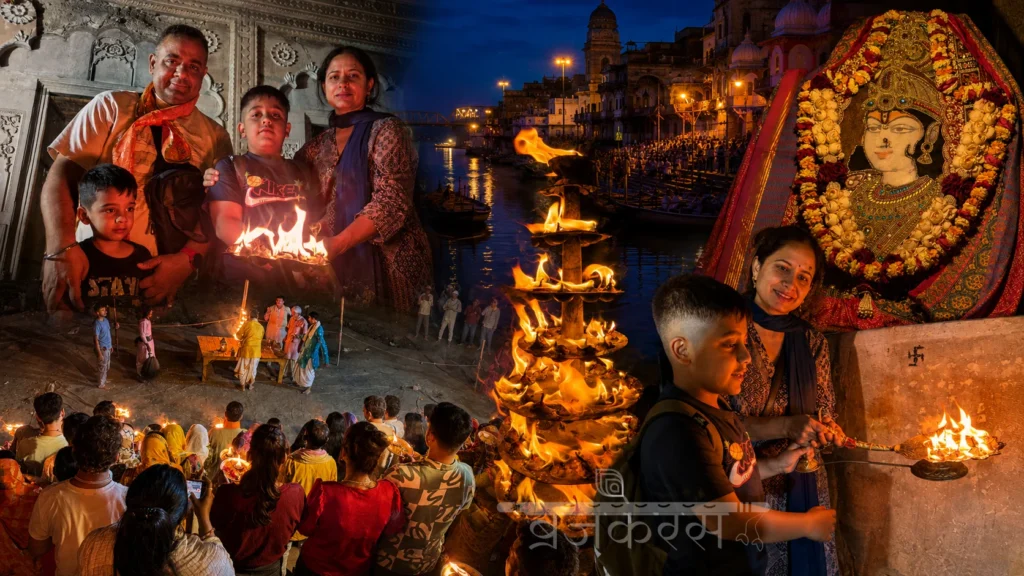
What Is Yamuna Aarti Like in Vrindavan?
As evening approaches, visitors begin gathering near the ghats for Yamuna Aarti.
Lamps are lit and offered to Yamuna Ji. Mantras and devotional songs fill the riverside air. Flames reflect across the moving water.
Some people participate closely. Some stand back and watch.
Either way, it can become one of the strongest memories of a Vrindavan visit.
There is something deeply human about a river ceremony.
Water keeps moving. Flames tremble. Bells ring. People fold their hands.
Then the ceremony ends, and ordinary life returns almost immediately.
Someone checks their phone. A child asks for something to eat. A boatman calls out to visitors. Families start walking back through the lanes.
Sacred and ordinary life sit side by side in Braj. They always have.
A Boat Ride Can Show You Another Vrindavan
A boat ride on Yamuna Ji offers a different perspective of the town.
From the river, the ghats and temples appear as part of one continuous riverside settlement rather than separate destinations.
You begin noticing old buildings, steps, shrines and architectural details that are easy to miss from crowded streets.
Early morning and late afternoon are usually the most pleasant times.
And perhaps keep the phone down for part of the ride.
Take photos, of course. Everyone does.
But leave ten minutes for simply looking.
Travel sometimes becomes a strange race to collect proof that we travelled. Braj works better when you give it some unrecorded time too.
Yamuna Ji in Braj Bhakti
The connection between Yamuna Ji and Braj extends far beyond famous Krishna stories.
For centuries, poets, acharyas and saints associated with Krishna bhakti have praised her.
One celebrated example comes from Shri Vallabhacharya, who composed the Yamunashtakam, a devotional hymn in praise of Shri Yamuna.
Within the Pushtimarg tradition, Yamuna Ji holds a deeply revered position, and the Yamunashtakam remains part of devotional practice.
Other Braj traditions remember the Yamuna through padavali poetry, kirtan, temple worship and oral storytelling.
This matters for travellers interested in the culture of Braj.
The region isn’t shaped by one monument or one historical period. Its identity grew through layers — ancient sacred texts, medieval bhakti movements, temple traditions, local customs, Braj Bhasha poetry and living pilgrimage.
Yamuna Ji runs through many of those layers.
Quite literally, in some cases.
Yamuna Ji Connects the Sacred Geography of Braj
Vrindavan receives much of the attention today, but Braj is much larger than Vrindavan.
Traditionally, Braj is associated with the land of Krishna’s childhood pastimes and includes places such as Mathura, Gokul, Mahavan, Govardhan, Barsana, Nandgaon and many smaller sacred sites.
Yamuna Ji helps connect several of these places.
A traveller interested in Krishna’s life can build a Braj visit around that geography rather than seeing isolated tourist spots.
Start with Mathura, associated with Krishna Janmabhoomi.
Continue to Gokul and Mahavan, connected with His early childhood.
Spend time in Vrindavan, visiting its temples, ghats and leela sthalis.
Then travel deeper into Braj — Govardhan, Radha Kund, Barsana and Nandgaon.
Suddenly the trip has a narrative.
You’re following stories across actual places.
When Should You Visit Yamuna Ji?
Vrindavan changes with the seasons.
October through March generally brings cooler weather, making long walks, temple visits, and time beside the river more comfortable.
Festivals create a completely different experience.
Janmashtami fills Mathura and Braj with celebrations connected with Krishna’s birth.
Radhashtami carries special importance across the region, particularly around Barsana.
Kartik month has a deeply devotional atmosphere. Many pilgrims perform parikrama, offer lamps and spend extended time in temple worship.
Then there is Holi.
Braj Holi has its own personality — colourful, devotional and sometimes wonderfully chaotic. Barsana, Nandgaon, Mathura and Vrindavan each have associated celebrations and customs.
Festival visits can be unforgettable, but expect crowds.
Big crowds.
If you prefer a slower experience, ordinary weekdays outside major festival dates may suit you better.
Please Treat Yamuna Ji Like a Sacred River
This part deserves attention.
If we visit Yamuna Ji as pilgrims or travellers, our behaviour beside the river matters.
Avoid leaving plastic bottles, food packaging, bags or other waste near the ghats. Be thoughtful with ritual offerings too. Natural flowers may feel harmless, yet offerings wrapped in plastic or mixed with synthetic material create waste.
Respect local worship.
Ask before photographing people at close range, particularly during personal rituals.
Dress with awareness that you’re visiting active sacred places rather than a staged tourist setting.
And don’t treat every corner as content for social media.
Some moments deserve privacy.
Braj gives visitors a lot. Visitors can return a little care.
Don’t Visit Yamuna Ji as a Checklist
Here’s the funny thing about Vrindavan.
You can technically “see” a lot in one day and still miss the place.
Banke Bihari Temple. Done.
Prem Mandir. Done.
ISKCON. Done.
Keshi Ghat. Photo taken.
Next.
But Braj doesn’t reveal itself particularly well through a checklist.
Give Yamuna Ji a morning.
Walk beside the ghats. Attend aarti. Take a boat ride if conditions permit. Learn why a particular ghat carries its name. Read a little about Krishna’s Yamuna leelas before visiting.
Then something changes.
Places begin connecting with stories, and stories begin connecting with devotion.
Yamuna Ji Is Still Flowing Through Braj
Centuries have passed since saints composed verses beside the Yamuna.
Vrindavan has grown. Roads have changed. New temples, hotels, cafés and buildings have appeared. Pilgrims now arrive carrying smartphones, booking rooms online and finding temples through Google Maps.
Yet people still come to the river.
They fold their hands.
They light diyas.
They say, “Yamuna Maiya ki Jai.”
Perhaps that continuity explains why Yamuna Ji remains so important to Vrindavan.
She connects ancient stories with present-day devotion. She connects Mathura with Gokul and Vrindavan. She connects scripture, geography, poetry and everyday Braj life.
And for someone visiting Braj, she offers something that can’t really be hurried.
So when you come to Vrindavan, visit the famous temples. Walk through the old lanes. Eat the local kachori and peda. Explore the places associated with Shri Radha and Krishna.
But save some time for Yamuna Ji.
Go early one morning, before the day becomes noisy.
Sit near the river.
Watch Braj wake up.
Sometimes that quiet hour beside Yamuna Ji explains Vrindavan better than a hundred guidebooks ever could.
Frequently Asked Questions About Yamuna Ji in Vrindavan
Why is Yamuna Ji sacred in Vrindavan?
Yamuna Ji is worshipped as a divine goddess and holds a special place in Krishna bhakti. Many leelas of Shri Krishna are connected with her waters and banks, including Vasudeva crossing the Yamuna with newborn Krishna and Krishna subduing Kaliya Nag. For devotees in Braj, she is lovingly worshipped as Yamuna Maiya and Shri Yamuna Maharani.
Which are the famous Yamuna ghats in Vrindavan?
Keshi Ghat is one of the best-known ghats on the Yamuna in Vrindavan and is traditionally associated with Shri Krishna’s Keshi leela. Kaliya Ghat is linked with the Kaliya Nag leela. Several smaller ghats and sacred spots can be found along the Vrindavan riverfront.
What is special about Keshi Ghat in Vrindavan?
Keshi Ghat is traditionally associated with Shri Krishna defeating the horse demon Keshi. Its historic riverside architecture and connection with Krishna leela have made it one of Vrindavan’s most recognised sacred places. Pilgrims visit for Yamuna darshan, prayer, boating and the riverside atmosphere.
Can visitors attend Yamuna Aarti in Vrindavan?
Yes. Devotees and visitors can experience Yamuna Aarti along the ghats of Vrindavan. Lamps, prayers, and devotional songs are offered to Yamuna Ji during the ceremony. Timings can vary by season and local arrangements, so checking locally on the day of your visit is sensible.
Can you take a boat ride on Yamuna Ji in Vrindavan?
Boat rides are commonly available along parts of the Yamuna riverfront in Vrindavan. Early morning and the period around sunset can offer beautiful views of the ghats. Availability may change with river conditions, weather, and local restrictions.
What is the connection between Yamuna Ji and Shri Krishna?
Yamuna Ji appears throughout the sacred accounts of Krishna’s life in Braj. Vasudeva crossed the Yamuna while carrying newborn Krishna to Gokul. Krishna later played near her banks and performed the famous Kaliya Mardan leela in her waters. This connection gives Yamuna Ji a deeply loved place in Braj devotion.
What is Yamunashtakam?
Yamunashtakam is a devotional hymn composed by Shri Vallabhacharya in praise of Shri Yamuna. It holds particular significance within the Pushtimarg tradition and expresses the divine glory and grace associated with Yamuna Ji.
What is the best time to visit Yamuna Ji in Vrindavan?
October to March usually offers more comfortable weather for visiting Vrindavan’s ghats and exploring Braj. Kartik is particularly significant for many devotees. Janmashtami, Holi and other Braj festivals offer a very different experience, though visitors should expect much larger crowds.
Which places can I visit near Yamuna Ji in Braj?
A Braj pilgrimage can connect Vrindavan with Mathura, Gokul, Mahavan, Govardhan, Radha Kund, Barsana and Nandgaon. Together, these sacred places help visitors understand the geography associated with Shri Radha, Shri Krishna and the leelas of Braj.