
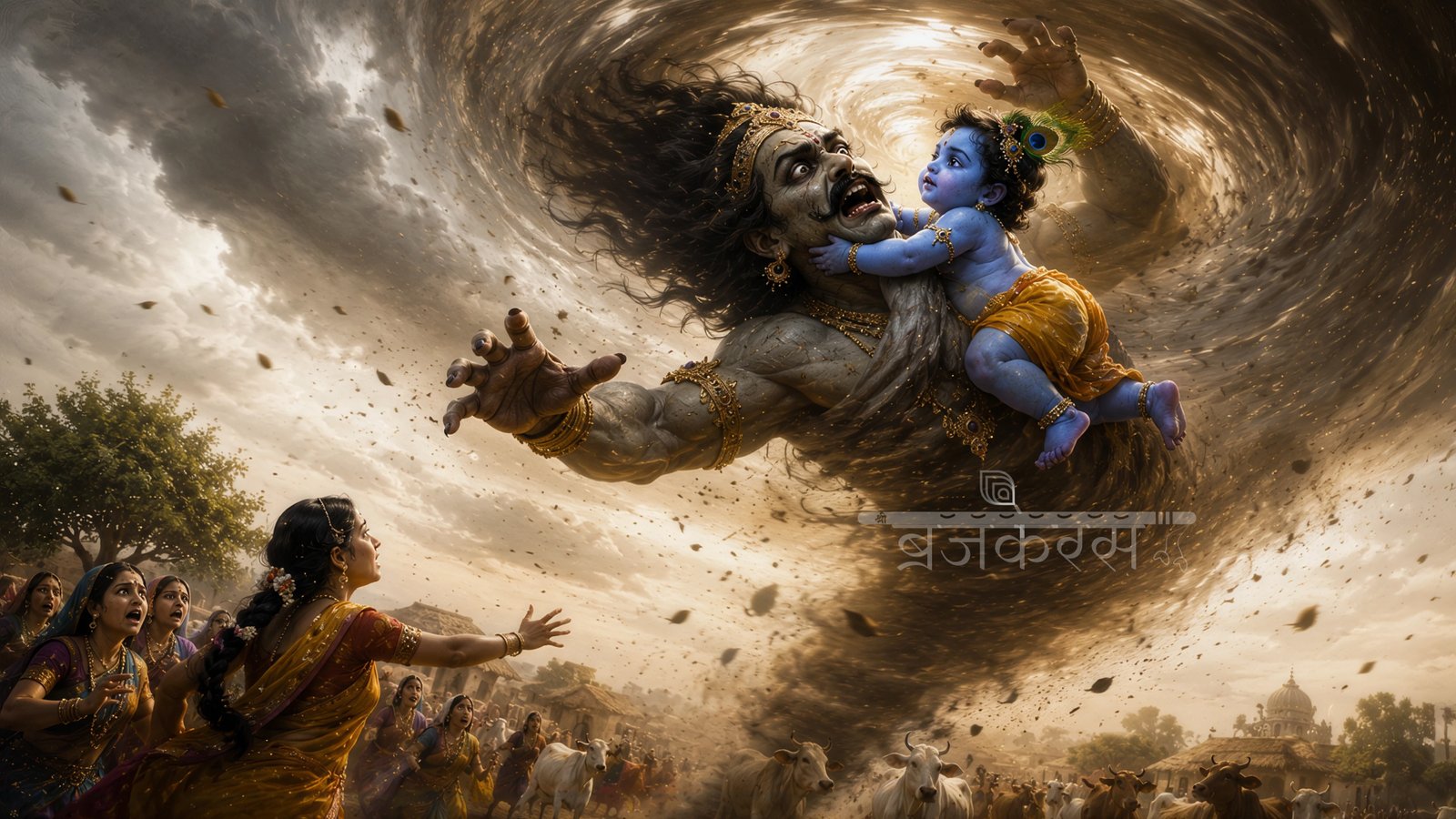
Trinavarta Vadh Leela: When Baby Krishna Defeated the Demon of the Whirlwind
Imagine a quiet day in Gokul.
Maa Yashoda has little Krishna in her lap. The child who recently survived Putna’s poisonous attack is growing, playing, and filling Nanda Baba’s home with the small joys familiar to every parent.
Then something strange happens.
Krishna suddenly feels heavy.
Very heavy.
Yashoda can no longer comfortably hold him, so she gently places him on the ground and returns to her household work.
A short time later, the sky changes.
Wind tears through Gokul. Dust rises from the earth. Visibility disappears. People can barely see one another.
And Krishna is gone.
This is Trinavarta Vadh Leela, one of the remarkable childhood Leelas of Shri Krishna described in the Śrīmad Bhāgavatam.
Trinavarta arrives as a violent whirlwind, lifts baby Krishna high into the sky, and expects an easy victory.
Instead, the child in his grip becomes heavier and heavier.
The demon who thought he could carry Krishna discovers something rather inconvenient.
You can’t carry the one who carries creation.
Who Was Trinavarta?
Trinavarta was a powerful Asura associated with Kansa, the tyrant king of Mathura.
Kansa lived under the shadow of a prophecy: Devaki’s eighth son would become the cause of his death.
That prediction consumed him.
He had tried imprisonment. He had ordered the killing of Devaki’s children. After Krishna was secretly carried to Gokul, Kansa sent dangerous beings to search for the mysterious child.
Putna was one of them.
Trinavarta was another.
His power was tied to the wind.
He could take the form of a violent whirlwind, fill the air with dust, and carry his victim high above the ground.
It was a clever method.
No obvious attacker.
No sword.
No army.
Just wind, dust and confusion.
By the time anyone understood what was happening, the child would be gone.
At least, that was the plan.
Plans tend to behave strangely around Krishna.
A Normal Day Takes an Unexpected Turn
Before Trinavarta appears, the Śrīmad Bhāgavatam gives us a tender domestic scene.
Maa Yashoda is holding Krishna.
This detail matters.
Krishna’s childhood Leelas often move between two extremes. One moment feels completely ordinary: feeding a baby, carrying him, putting him to sleep.
The next moment reveals something cosmic.
Yashoda holds Krishna as any loving mother would.
Then his weight begins to increase.
She becomes surprised.
Why has her little boy suddenly become so heavy?
Unable to continue carrying him, she places Krishna on the ground.
To Yashoda, this may have seemed like one of those odd things babies do. Parents know the feeling. Children have a remarkable talent for making perfectly simple tasks unexpectedly difficult.
Yet Krishna’s increased weight seems to prepare the scene for what comes next.
Soon, Trinavarta arrives.
Then Gokul Disappears Behind Dust
Trinavarta transforms himself into a huge whirlwind.
The peaceful atmosphere changes almost instantly.
Dust rises everywhere.
The sky darkens.
Powerful winds sweep through the settlement.
Imagine trying to find a small child in that chaos.
People struggle to see.
Objects are thrown around.
Dust enters the eyes.
The familiar paths of Gokul vanish behind a moving wall of earth and air.
Amid the confusion, Trinavarta reaches Krishna.
He lifts the child from the ground and carries him upward.
Higher.
Higher still.
Within moments, baby Krishna is far above Gokul.
Down below, Maa Yashoda searches for him.
She cannot find her son.
Yashoda’s Fear Is Painfully Human
There is a tendency to read Krishna Leela knowing the ending.
We know Krishna is Bhagavan.
We know Trinavarta cannot defeat him.
We know Krishna will return safely.
Yashoda doesn’t experience the event that way.
She sees her child disappear.
That changes everything.
For her, this isn’t a theological demonstration.
It is a mother’s nightmare.
The Bhāgavatam describes Yashoda becoming overwhelmed with grief when she cannot find Krishna. She falls to the ground, distressed like a cow separated from her calf.
That comparison belongs naturally to Braj.
Cows and calves were part of everyday life there. People knew the restless cry of a mother cow searching for her young one.
Yashoda’s pain is expressed through that familiar image.
This is one reason Krishna’s Braj Leelas feel so intimate.
The divine appears through recognisable emotions.
A mother worries.
Neighbours rush to help.
People search.
No one calmly says, “Don’t worry, he is the Supreme Lord.”
Love doesn’t work like that.
Meanwhile, Trinavarta Thinks He Has Won
High above the ground, Trinavarta carries Krishna through the sky.
From the demon’s point of view, everything has worked perfectly.
The dust storm blinded the villagers.
Krishna has been taken away.
No one can reach them.
The tiny child appears completely helpless.
Then Krishna begins to get heavier.
At first, perhaps Trinavarta can manage.
Then the weight increases.
And increases.
Soon the demon can no longer rise.
The child in his arms feels unbearably heavy.
This is where the Leela turns almost playful.
A demon whose power lies in lifting things into the air meets a baby who decides to become too heavy to lift.
No elaborate weapon is needed.
No battlefield.
Krishna simply becomes heavy.
How Heavy Can a Baby Become?
Trinavarta begins losing control.
Krishna’s weight becomes impossible for him to bear.
The demon struggles to remain in the sky.
Then baby Krishna grabs his throat.
Those tiny hands close around Trinavarta’s neck.
The demon cannot breathe.
His eyes begin to bulge.
He tries to escape Krishna’s grip, but there is nowhere to go.
The same child he carried away as prey now feels like a mountain around his neck.
Trinavarta falls from the sky.
His massive body crashes onto a stone surface below.
He dies.
And Krishna?
He remains unharmed.
The villagers later find the little child sitting safely upon the demon’s enormous body.
It is one of those Krishna Leela images that almost refuses to behave logically.
A giant demon lies dead.
A tiny baby sits comfortably on top.
Who defeated whom is rather obvious.
The Villagers Find Krishna
Once the whirlwind stops, the dust begins to settle.
People can see again.
Then the residents of Gokul discover the huge body of Trinavarta.
Krishna is there.
Safe.
Imagine the relief.
The Gopis pick him up and return him to Maa Yashoda.
The people are amazed.
How could a small child survive such a disaster?
They begin reflecting on their past good deeds and religious acts. Perhaps, they think, some accumulated merit has protected the child.
This response tells us something beautiful about the residents of Braj.
They witness impossible events around Krishna yet continue relating to him through affection.
Krishna doesn’t become an abstract cosmic principle to them.
He remains Kanha.
Their Kanha.
The child who must be fed, protected and carried home.
Krishna Became Heavy for a Reason
The change in Krishna’s weight forms one of the most memorable parts of Trinavarta Vadh Leela.
The demon represents movement.
Air.
Restlessness.
He rises upward with tremendous force.
Krishna answers with weight.
There is an interesting spiritual contrast here.
The mind can sometimes behave like Trinavarta.
One thought becomes ten.
A small worry becomes a storm.
Pride lifts us into imaginary heights.
Confusion fills the inner space with so much dust that we stop seeing what is right in front of us.
Then something grounding is needed.
Krishna becomes that weight.
Not weight as a burden.
Weight as stability.
A centre.
Something that stops the whirlwind from carrying us wherever it wants.
That reading has made Trinavarta especially meaningful for many devotees.
Is Trinavarta a Symbol of Pride?
Vaishnava teachers have often drawn spiritual lessons from the demons Krishna defeats.
Trinavarta is frequently connected with pride, false learning, argument, mental agitation or the tendency to rise above others through ego.
Think about the imagery.
Trinavarta goes upward.
He creates dust.
People lose their vision.
He carries Krishna away from ordinary sight.
Pride behaves in a strangely similar fashion.
It lifts us.
Or rather, it makes us feel lifted.
“I know better.”
“I’m more spiritual.”
“I’m more successful.”
“I understand what everyone else is missing.”
A little dust enters the eyes.
Then clear vision disappears.
The higher ego carries us, the harder it becomes to see the ground.
Krishna reverses that movement.
He becomes heavy.
Trinavarta falls.
Sometimes grace feels like being lifted.
Sometimes grace brings us back down.
The Dust Storm Has Something to Say Too
There’s another detail worth sitting with.
Trinavarta doesn’t attack in clear daylight.
He fills the environment with dust first.
Why?
Confusion makes attack easier.
Again, the metaphor practically writes itself.
Many poor decisions don’t happen when the mind is calm. They happen inside emotional dust storms.
Anger.
Fear.
Envy.
Pride.
Anxiety.
The mind becomes noisy and visibility drops.
We react before we see.
We speak before we think.
Then, once the dust settles, we wonder, “Why did I do that?”
Trinavarta Vadh Leela gives this inner experience a dramatic physical form.
The answer isn’t to fight every particle of dust.
Find the centre.
Hold Krishna.
Or perhaps more accurately, let Krishna hold you.
The One Who Carries Everything Cannot Be Carried Away
There is a lovely contradiction at the centre of the Leela.
Trinavarta carries Krishna.
Yet Krishna is the source of Trinavarta’s own strength.
The demon uses the power of wind, but the wind itself moves under divine order.
He uses strength borrowed from the very reality he is trying to defeat.
It’s like a wave trying to steal the ocean.
For a few moments, it may look dramatic.
The outcome was never really in doubt.
This theme appears throughout Krishna’s childhood.
His enemies repeatedly mistake smallness for weakness.
They see a baby.
They don’t see Bhagavan.
Putna sees an infant she can poison.
Shakatasura sees a vulnerable child beneath a cart.
Trinavarta sees someone light enough to carry into the sky.
Each mistake comes from judging Krishna through ordinary measurement.
And Krishna keeps breaking the measuring tools.
Why Didn’t Krishna Simply Stop Trinavarta Earlier?
A reader may reasonably ask this.
If Krishna could destroy Trinavarta at any moment, why allow himself to be carried away?
Why let Yashoda suffer?
Why let Gokul become frightened?
Krishna Leela isn’t structured like a security system whose sole purpose is preventing incidents.
Leela reveals relationships.
Through these events, the affection of Braj becomes visible.
Yashoda’s love appears more clearly when Krishna disappears.
The villagers’ attachment becomes visible when they search for him.
Krishna’s divine power appears without destroying the sweetness of his childhood form.
And Trinavarta’s confidence exposes its own emptiness.
For the residents of Braj, every danger somehow deepens their attachment to Krishna.
Fear ends.
Love remains.
What Trinavarta Vadh Leela Can Teach Us
Ancient Leelas stay alive partly because people keep recognising themselves inside them.
Trinavarta may be a supernatural whirlwind demon, but some of his patterns feel surprisingly familiar.
A few reflections stand out:
- Pride can cloud vision. Trinavarta fills the air with dust before carrying Krishna away.
- A restless mind needs a centre. Krishna’s increasing weight represents a powerful image of spiritual grounding.
- Appearances can mislead. Trinavarta sees a helpless baby and completely misjudges who is in his hands.
- Divine protection may work quietly. Krishna needs no dramatic weapon. His own presence defeats the demon.
- Love doesn’t calculate safety through philosophy. Yashoda knows Krishna through motherhood, so she worries for him like any mother would.
- Going higher isn’t always progress. Ego can rise too. Sometimes spiritual growth feels more like becoming grounded.
That final point is easy to overlook.
We often associate growth with climbing.
Higher knowledge.
Higher status.
Higher achievement.
Braj gives us another picture.
Become grounded enough that the storm cannot carry you away.
Krishna Returns to Yashoda
After all the cosmic drama, Trinavarta Vadh Leela returns to something wonderfully simple.
Krishna goes back to his mother.
The demon is dead.
The whirlwind has vanished.
The dust settles over Gokul.
Life continues.
Cows still need tending. Milk still needs churning. Children still play. Yashoda has her Kanha again.
That return matters.
Krishna’s divine power doesn’t remove him from ordinary affection. It brings him straight back into it.
He can become heavier than Trinavarta can bear, choke a giant demon and survive a fall from the sky.
Then he can sit in Yashoda’s lap.
This is the sweetness of Braj.
Infinite power wrapped in childhood innocence.
When the Whirlwind Finally Stops
Trinavarta entered Gokul with noise.
Wind.
Dust.
Force.
He seemed unstoppable.
Yet his greatest mistake was taking Krishna into his own hands.
The higher he carried Krishna, the heavier Krishna became.
The demon who controlled the whirlwind eventually couldn’t control his own flight.
Then the tiny hands of Kanha closed around his throat.
The storm ended.
There’s a quiet message here for anyone who has ever felt mentally scattered, proud, frightened, or pulled in too many directions.
Storms feel powerful when we’re inside them.
Dust can make a familiar road disappear.
But the road hasn’t actually gone anywhere.
Wait for the dust to settle.
Return to what has weight.
Return to what is real.
For the people of Braj, that centre was Krishna.
And perhaps that is why Trinavarta Vadh Leela remains so memorable.
A demon tried to carry Krishna away into the sky.
Krishna became too heavy to carry.
Pride rose.
Grace brought it down.
The whirlwind passed.
And little Kanha returned safely to Maa Yashoda’s arms.