Category: Daily Leelas

  • Damodar Leela

    Damodar Leela

    Damodar Leela tells how Maa Yashoda chased mischievous Krishna and tied him to a mortar. Her rope kept falling short until Krishna lovingly allowed his mother to bind him.

    Can God be tied with a piece of rope?

    It sounds impossible.

    How could the one who holds countless universes within himself be restrained by a village mother? How could the Supreme Lord, whom sages seek through meditation and prayer, stand frightened before Maa Yashoda with tears in his eyes?

    Yet this is exactly what happens in Damodar Leela, one of the sweetest childhood Leelas of Shri Krishna.

    There is no battlefield here.

    No terrifying demon arrives.

    No great weapon appears.

    The setting is wonderfully ordinary: a mother, a mischievous child, a broken pot of curd, stolen butter, a wooden grinding mortar, and a rope that somehow refuses to become long enough.

    Then something remarkable happens.

    Maa Yashoda binds Krishna.

    Or perhaps Krishna allows himself to be bound.

    That small distinction carries the whole beauty of the Leela.

    It Begins With Yashoda Churning Curd
    Damodara Lila
    Maa Yashoda Churning Milk

    The Śrīmad Bhāgavatam places us inside the household of Nanda Baba in Gokul.

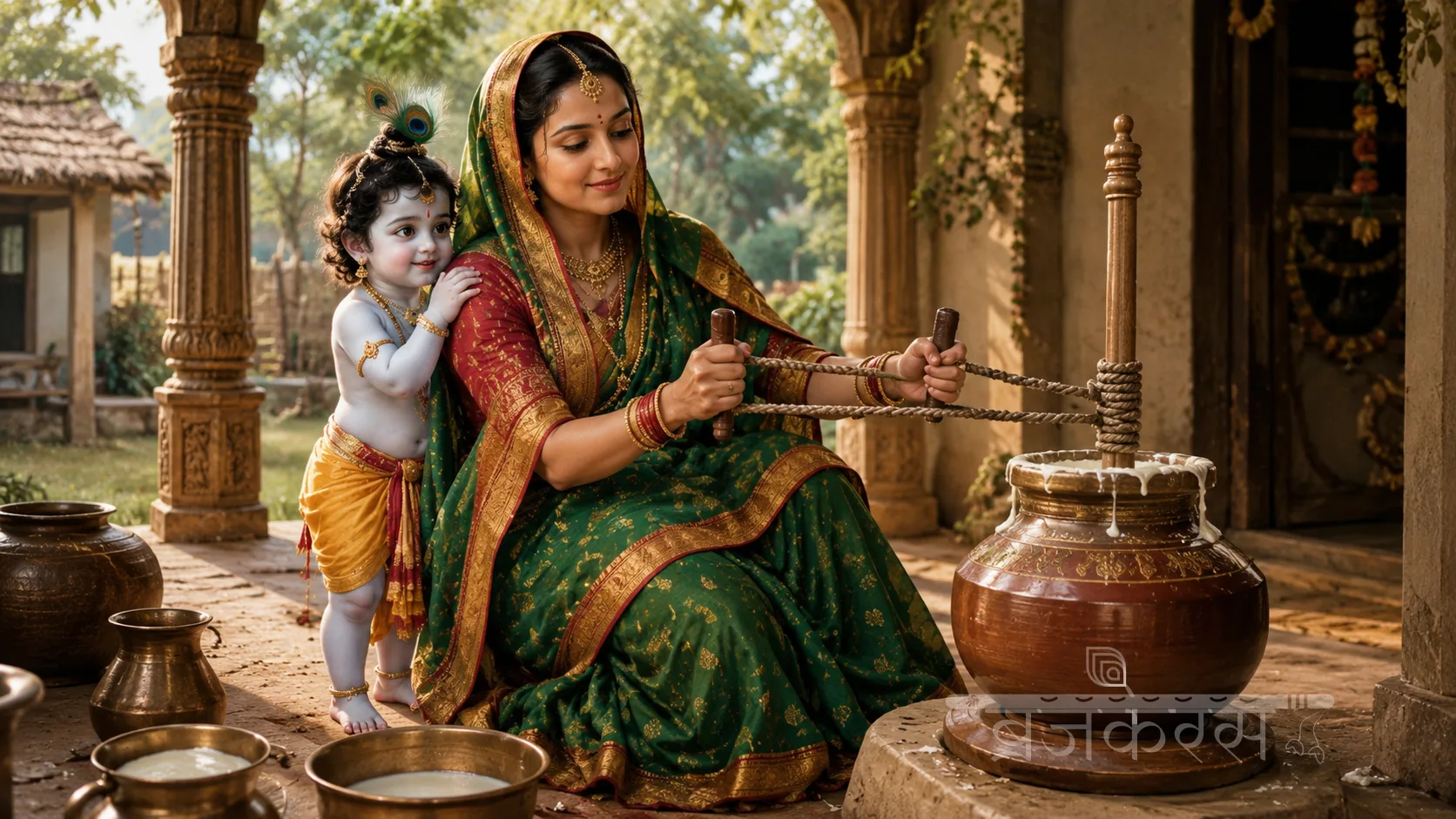
    Early one morning, Maa Yashoda is churning curd.

    Picture the scene.

    The rhythmic sound of the churning rope fills the home. Her bangles move against one another. She sings about Krishna’s childhood activities as she works.

    There is something deeply Braj-like about this image.

    Devotion isn’t separated from daily life.

    Yashoda doesn’t need to leave her home to remember Krishna. She remembers him while making butter.

    Work becomes remembrance.

    Then little Krishna wakes up.

    And he is hungry.

    He approaches his mother and wants milk.

    Right now.

    Anyone who has spent time around a hungry toddler knows there isn’t much room for negotiation here.

    Yashoda stops churning and takes Krishna into her lap.

    She begins feeding him.

    For a few peaceful moments, Kanha has exactly what he wants.

    Then milk boiling on the stove begins to rise.

    Yashoda notices.

    She gently puts Krishna down and rushes to save the milk before it spills.

    A sensible decision.

    Krishna doesn’t agree.
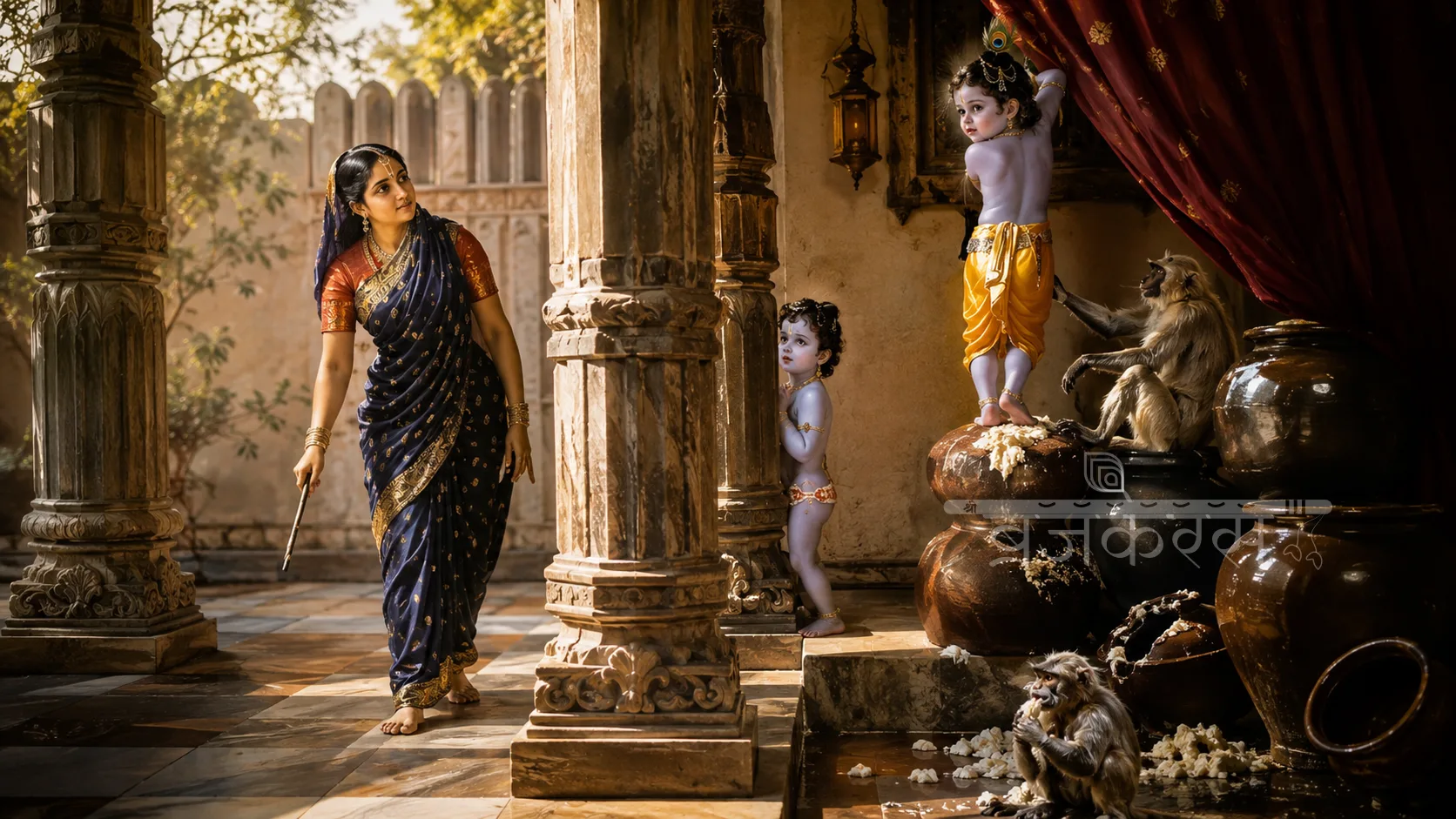
    damodar leela

    Krishna Is Not Happy About Being Left Behind

    Little Krishna becomes upset.

    His mother had been feeding him.

    Then she suddenly left.

    From an adult point of view, Yashoda had a perfectly good reason. Milk was about to boil over.

    From Krishna’s point of view?

    Maa left me.

    That’s enough.

    His lips tremble with anger.

    Then the butter thief gets an idea.

    Krishna picks up a stone and breaks the pot of curd.

    Yes, the Supreme Lord throws a tantrum.

    This is part of the charm of Braj Bhakti. Krishna isn’t presented only through grandeur and divine authority. He becomes a child with moods, mischief, and a very clear opinion about interrupted meals.

    After breaking the pot, Krishna goes elsewhere and begins eating freshly churned butter.

    He doesn’t keep it all for himself either.

    He feeds some to the monkeys.

    There’s something wonderfully cheeky about the scene.

    Yashoda had been working to make butter for the household.

    Krishna becomes the unofficial distribution manager.

    The monkeys are delighted.

    Yashoda Discovers the Crime Scene

    When Maa Yashoda returns, she sees the broken curd pot.

    It doesn’t take Sherlock Holmes to work out what happened.

    She knows her son.

    Following the little clues, she finds Krishna sitting near an overturned wooden grinding mortar, eating butter and sharing it with monkeys.

    Krishna keeps looking around nervously.

    He knows he has been caught.

    Yashoda approaches with a small stick in her hand.

    Krishna sees her.

    And runs.

    Now comes one of the most loved scenes in Krishna’s childhood.

    The Supreme Lord runs away from his mother.

    Wait… Krishna Is Afraid?

    Think about that for a moment.

    Kansa fears Krishna.

    Putna couldn’t survive his touch.

    Trinavarta carried him into the sky and died when Krishna gripped his throat.

    Yet the same Krishna runs when Yashoda approaches with a stick.

    How?

    The answer lies in the relationship.

    Krishna isn’t afraid of Yashoda’s physical strength.

    He responds to her love.

    Braj turns ordinary spiritual hierarchy upside down.

    The devotee bows before God.

    Yet here God runs before his devotee.

    Yashoda chases him through the courtyard.

    Krishna is quick.

    Yashoda isn’t exactly dressed for a sprint. She has been doing household work; her body is tired, flowers begin falling from her hair, and she struggles to keep pace.

    Still, she doesn’t give up.

    Eventually she catches him.

    One can almost imagine Krishna looking back and thinking, “Ah. This has become serious.”

    Tears in Krishna’s Eyes

    When Yashoda catches Krishna, she sees him crying.

    He rubs his eyes with his little hands.

    The black kajal around them becomes smeared.

    He looks frightened.

    This image has been cherished by poets, saints, painters and devotees for centuries.

    The fearless Lord is afraid of his mother.

    Not fake fear.

    Not a theatrical performance in the ordinary sense.

    Within the sweetness of his Leela, Krishna accepts the emotional reality of being Yashoda’s child.

    She sees her mischievous son.

    She doesn’t see the ruler of creation standing before her.

    That lack of divine distance is one of the defining features of Vatsalya Bhava—devotion expressed through parental love.

    Yashoda decides she needs to stop Krishna from running off and causing more mischief.

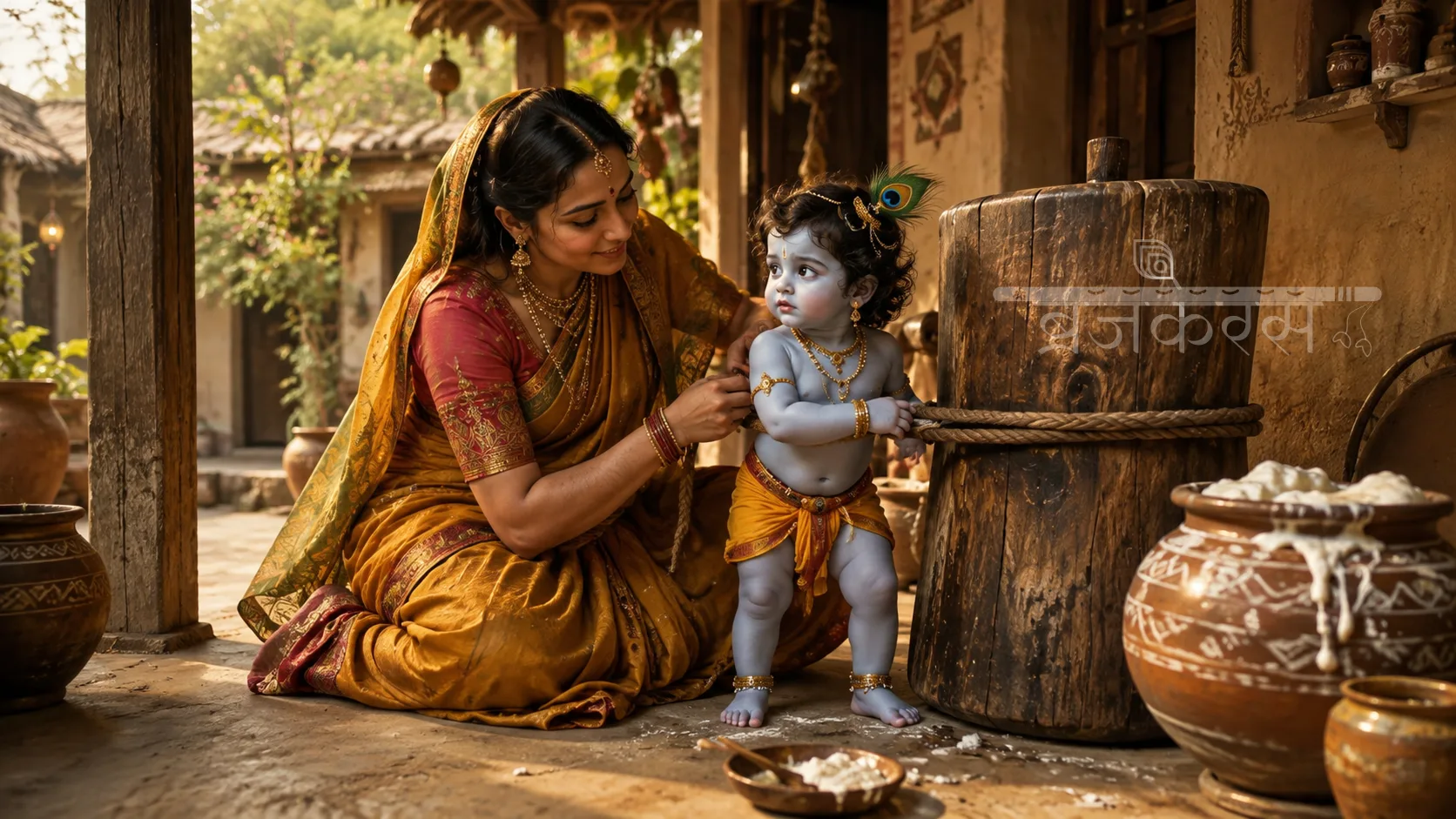
    So she tries to tie him to a wooden grinding mortar.

    Simple enough.

    Except the rope doesn’t fit.

    The Rope Is Two Fingers Too Short

    Yashoda takes a rope and wraps it around Krishna’s waist.

    It is too short.

    By how much?

    Two fingers.

    So she gets another piece of rope and ties it to the first.

    She tries again.

    Still two fingers short.

    Another rope is added.

    Still short.

    More rope.

    Same result.

    At this point, the situation becomes wonderfully strange.

    Krishna is a small child.

    Yashoda has gathered plenty of rope.

    Mathematically, this problem should have been solved several ropes ago.

    Yet every attempt ends in the same way.

    Two fingers short.

    Shukadev Goswami tells King Parikshit:

    न चान्तर्न बहिर्यस्य न पूर्वं नापि चापरम् ।
    पूर्वापरं बहिश्चान्तर्जगतो यो जगच्च य: ॥
    na chantar na bahir yasya na purvam napi chaparam
    purvaparam bahish chantar jagato yo jagachcha yah

    People from the household begin watching.

    More rope is brought.

    Yashoda joins piece after piece.

    Still, Krishna cannot be bound.

    The little boy’s waist hasn’t visibly grown.

    The rope simply refuses to reach.

    Why Was the Rope Always Two Fingers Short?

    This detail has inspired a beautiful devotional interpretation.

    Many Vaishnava teachers explain the two-finger gap as representing two elements in Bhakti:

    One finger represents the devotee’s sincere effort, and the other represents Krishna’s grace.

    Effort alone cannot bind Krishna.

    Grace without loving engagement doesn’t describe Yashoda’s experience either.

    Both meet.

    Yashoda keeps trying.

    She doesn’t throw the rope aside after the second attempt and say, “Well, apparently this isn’t meant to happen.”

    She works.

    She sweats.

    She gathers more rope.

    She persists out of love.

    Krishna watches.

    Then he sees that his mother is exhausted.

    Her hair has loosened.

    Her body is tired.

    She has done everything she can.

    Krishna’s heart softens.

    And suddenly the rope fits.

    Same Krishna.

    Same mother.

    Same task.

    Something has changed.

    Krishna has agreed to be bound.

    You Cannot Force Krishna, But Love Can Hold Him

    This is the centre of Damodar Leela.

    Yashoda doesn’t overpower Krishna.

    Krishna allows her love to overpower him.

    The distinction is beautiful.

    No amount of rope could bind the limitless Lord without his consent. Yashoda could have tied together every rope in Gokul and remained two fingers short.

    Then Krishna sees her loving effort.

    He gives himself.

    Bhakti traditions return to this idea again and again: God may be infinite, yet loving devotion creates intimacy with him.

    Knowledge can describe his greatness.

    Meditation can contemplate him.

    Ritual can honour him.

    Love does something unexpectedly personal.

    It makes Krishna belong to Yashoda.

    Why Is Krishna Called Damodar?

    The name Damodar comes from Sanskrit.

    Dama refers to rope.

    Udara means belly or abdomen.

    Damodar, then, refers to the Lord whose belly was bound with a rope.

    It’s an extraordinary divine name when you think about it.

    Many names of God celebrate power, majesty, protection, or cosmic authority.

    Damodar remembers the day God got caught stealing butter and his mother tied him up.

    Only Braj could give us something quite like this.

    The name preserves a relationship.

    Whenever devotees say “Damodar,” they remember Krishna’s willingness to become subordinate to Yashoda’s affection.

    That is why this Leela holds such a beloved place in Vaishnava devotion.

    The Infinite Belly and a Village Rope

    There is another beautiful paradox hidden in Krishna’s name.

    Yashoda ties a rope around Krishna’s belly.

    This is the same child whose mouth, in another famous Leela, reveals the cosmic creation to his mother.

    Universes exist within him.

    Yet a rope from Nanda Baba’s household goes around his waist.

    How can both be true?

    Krishna Leela doesn’t rush to flatten the contradiction.

    It lets both truths sit together.

    Krishna is infinite.

    Krishna is Yashoda’s child.

    His divinity doesn’t cancel his childhood intimacy.

    His childhood doesn’t reduce his divinity.

    This meeting of majesty and affection gives Braj Bhakti its particular sweetness.

    The limitless becomes reachable.
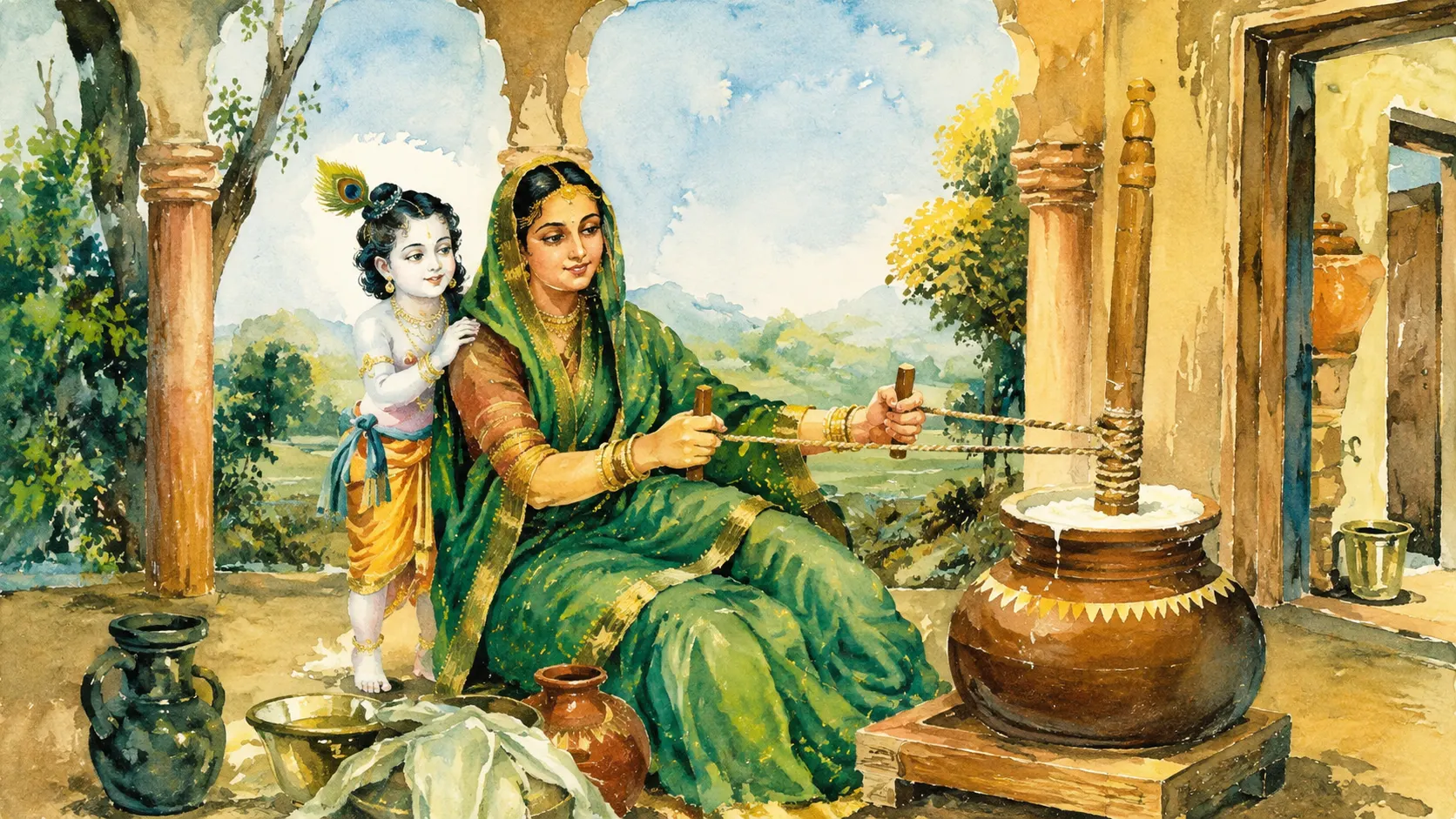
    damodar leela yashodha churning milk

    Krishna Is Bound, but the Story Isn’t Finished

    After tying Krishna to the wooden grinding mortar, Yashoda returns to her household duties.

    One might expect Krishna to sit quietly and reconsider his life choices.

    He doesn’t.

    There are two tall Arjuna trees nearby.

    These trees have a story of their own.

    According to the Śrīmad Bhāgavatam, they were connected with Nalakuvara and Manigriva, sons of Kubera.

    The two had become intoxicated by wealth and pleasure. The sage Narada encountered them and gave them a curse that was really a hidden blessing: they would take the form of trees until Krishna personally freed them.

    Years passed.

    They stood in Nanda Baba’s courtyard as twin Arjuna trees.

    Then Damodar came crawling their way.

    Still tied to the mortar.

    Krishna Pulls the Mortar Between the Trees

    Krishna begins dragging the heavy wooden mortar behind him.

    He moves between the two Arjuna trees.

    The mortar becomes stuck.

    Krishna pulls.

    The trees crash down with tremendous force.

    Imagine hearing that from inside the house.

    A peaceful morning has already included broken curd, stolen butter, a chase through the courtyard, and an unusually complicated rope problem.

    Now two huge trees have fallen.

    Typical morning with Kanha.

    From the fallen trees emerge Nalakuvara and Manigriva in their celestial forms.

    They offer prayers to Krishna.

    Their long period of waiting has ended.

    Krishna grants them freedom.

    And here lies another lovely twist.

    Krishna himself is tied.

    Yet he liberates others.

    His body is bound to a mortar.

    His power is completely free.

    The Bound Lord Sets Others Free

    That image deserves a moment.

    Damodar is tied by Yashoda.

    Nalakuvara and Manigriva are tied by the consequences of their pride and past behaviour.

    Krishna’s binding comes from love.

    Their binding comes from attachment.

    The one bound by love frees those bound by ego.

    There’s almost a playful spiritual logic to it.

    The ropes around Krishna don’t diminish him.

    They reveal something about him.

    He willingly accepts loving bonds, then breaks the bonds that keep others away from him.

    This is why “freedom” in Bhakti can sound different from ordinary independence.

    The highest freedom isn’t always having no bonds.

    Sometimes it is choosing the right bond.

    Butter Theft Has a Deeper Meaning Too

    Krishna’s love for butter appears throughout Braj traditions.

    On the surface, it is delightful childhood mischief.

    Devotional poets often see another layer.

    Butter is produced through churning.

    Milk becomes curd. Curd is churned again and again until butter appears.

    The heart, too, is worked through remembrance, prayer, service and love.

    What remains after that inner churning?

    Something soft.

    Something Krishna wants.

    This is why Krishna stealing butter became such a beloved devotional image.

    He steals what the Gopis have prepared with affection.

    And if Krishna is a thief, devotees sometimes pray that he steal something else too.

    Pride.

    Anger.

    Greed.

    Fear.

    Take the whole lot, Kanha.

    No police complaint required.

    Damodar Leela During Kartik

    Damodar Leela holds a special place during the sacred month of Kartik, also known in many Vaishnava communities as Damodar month.

    Devotees offer lamps before Krishna and sing the famous Damodarashtakam, traditionally associated with Satyavrata Muni and preserved in the Padma Purana tradition.

    The prayer remembers Yashoda binding Krishna and celebrates the extraordinary power of loving devotion.

    During Kartik, temples and homes glow with rows of small lamps.

    A single diya may seem simple.

    That simplicity fits Damodar Leela perfectly.

    Yashoda doesn’t bind Krishna through wealth or status.

    She uses an ordinary rope.

    Love makes it extraordinary.

    What Damodar Leela Can Teach Us

    This childhood episode offers several reflections that remain surprisingly practical:

    • Sincere effort matters. Yashoda keeps trying when every rope falls short.
    • Grace cannot be forced. Krishna becomes bound when he chooses to respond to her loving effort.
    • Love changes relationships. The Supreme Lord accepts the role of Yashoda’s mischievous child.
    • Pride creates its own prison. Nalakuvara and Manigriva lose their freedom through arrogance and attachment.
    • Being grounded can be a gift. Krishna frees them from a life shaped by intoxication and privilege.
    • Ordinary actions can carry devotion. Churning curd, feeding a child and lighting a lamp can become acts of remembrance.

    There’s no need to make spirituality unnecessarily complicated.

    Yashoda didn’t deliver a lecture.

    She chased Krishna with a stick.

    Yet saints have spent centuries discussing what happened in that courtyard.

    So Who Really Bound Krishna?

    Yashoda used rope.

    But rope alone failed.

    Again.

    Again.

    Again.

    Only when Krishna saw her exhaustion did he allow himself to be tied.

    So what actually bound him?

    Her persistence?

    Her affection?

    His grace?

    All three meet in the same moment.

    That is why the image of Damodar feels so tender.

    The infinite Lord isn’t conquered through force.

    He responds to love.

    And he responds so completely that he allows himself to stand before Yashoda with tears in his eyes and rope around his belly.

    Two Fingers Short, Then Suddenly Enough

    Damodar Leela begins with a very ordinary interruption.

    Milk is boiling.

    Yashoda gets up.

    Krishna becomes annoyed.

    A pot breaks.

    Butter disappears.

    Monkeys get breakfast.

    A mother gives chase.

    Then the story quietly opens into one of Bhakti’s deepest ideas.

    Krishna cannot be measured by rope.

    He cannot be controlled through strength.

    Yet he chooses to become bound by affection.

    Yashoda’s rope remained two fingers short until effort met grace.

    Then the impossible became simple.

    The rope fit.

    The Lord was tied.

    And the same bound Krishna went on to free Nalakuvara and Manigriva.

    Perhaps that is the lasting beauty of Damodar Leela.

    We spend so much time trying to reach the divine through bigger things—greater knowledge, greater achievement, greater discipline.

    Braj gives us another image.

    A tired mother.

    A mischievous child.

    A piece of rope.

    Love.

    And God deciding that, for love, he is willing to be caught.
  • Trinavarta Vadh Leela

    Trinavarta Vadh Leela

    Trinavarta Vadh Leela: When Baby Krishna Defeated the Demon of the Whirlwind

    श्री कृष्ण लीला | तृणावत वध

    Imagine a quiet day in Gokul.

    Maa Yashoda has little Krishna in her lap. The child who recently survived Putna’s poisonous attack is growing, playing, and filling Nanda Baba’s home with the small joys familiar to every parent.

    Then something strange happens.

    Krishna suddenly feels heavy.

    Very heavy.

    Yashoda can no longer comfortably hold him, so she gently places him on the ground and returns to her household work.

    A short time later, the sky changes.

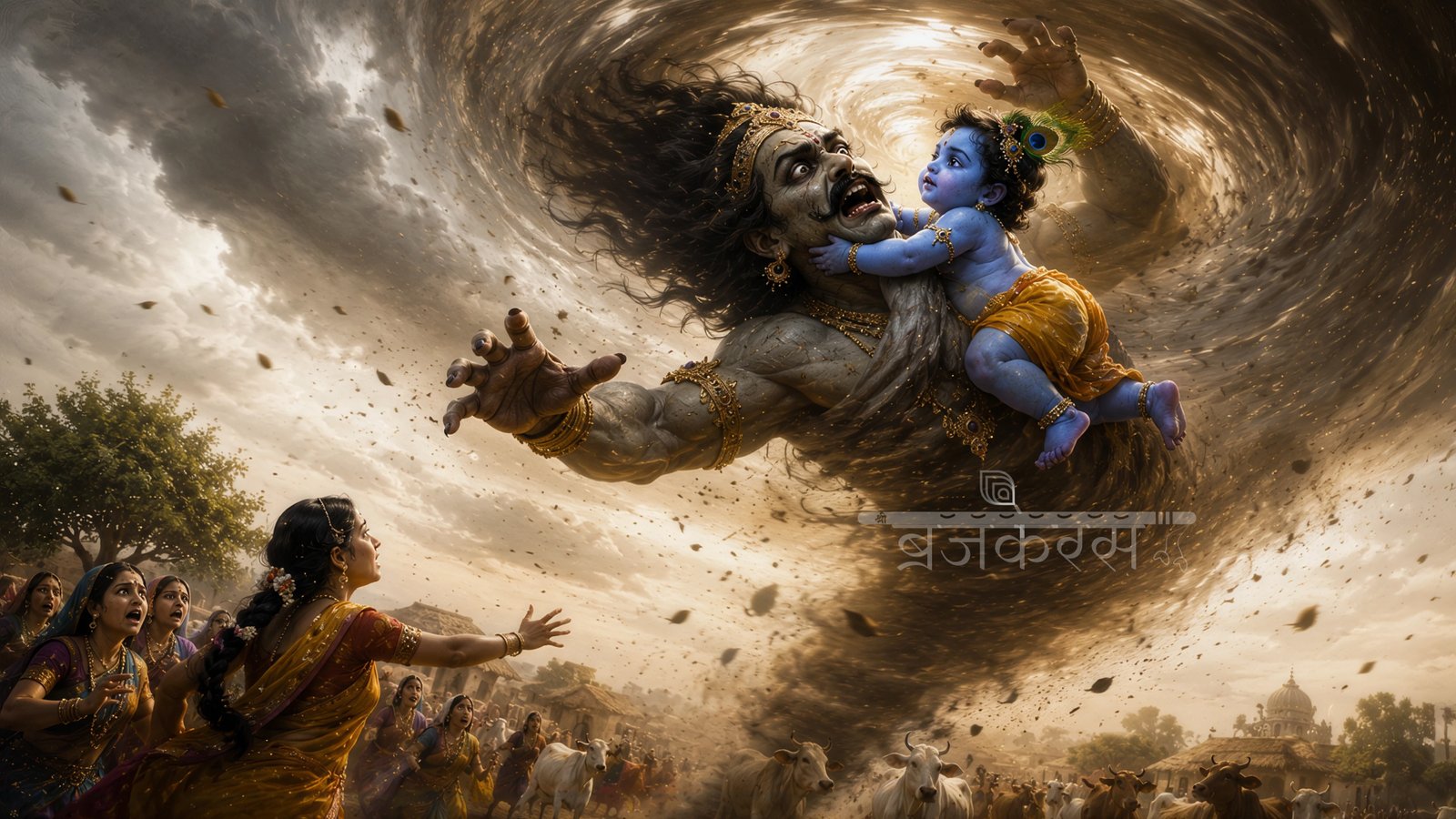
    Wind tears through Gokul. Dust rises from the earth. Visibility disappears. People can barely see one another.

    And Krishna is gone.

    This is Trinavarta Vadh Leela, one of the remarkable childhood Leelas of Shri Krishna described in the Śrīmad Bhāgavatam.

    Trinavarta arrives as a violent whirlwind, lifts baby Krishna high into the sky, and expects an easy victory.

    Instead, the child in his grip becomes heavier and heavier.

    The demon who thought he could carry Krishna discovers something rather inconvenient.

    You can’t carry the one who carries creation.

    Who Was Trinavarta?

    Trinavarta was a powerful Asura associated with Kansa, the tyrant king of Mathura.

    Kansa lived under the shadow of a prophecy: Devaki’s eighth son would become the cause of his death.

    That prediction consumed him.

    He had tried imprisonment. He had ordered the killing of Devaki’s children. After Krishna was secretly carried to Gokul, Kansa sent dangerous beings to search for the mysterious child.

    Putna was one of them.

    Trinavarta was another.

    His power was tied to the wind.

    He could take the form of a violent whirlwind, fill the air with dust, and carry his victim high above the ground.

    It was a clever method.

    No obvious attacker.

    No sword.

    No army.

    Just wind, dust and confusion.

    By the time anyone understood what was happening, the child would be gone.

    At least, that was the plan.

    Plans tend to behave strangely around Krishna.

    A Normal Day Takes an Unexpected Turn

    श्री कृष्ण लीला – तृणावर्त वध! | Yashomati Maiya Ke Nandlala | Trinavarta Vadh | Full Episode

    Before Trinavarta appears, the Śrīmad Bhāgavatam gives us a tender domestic scene.

    Maa Yashoda is holding Krishna.

    This detail matters.

    Krishna’s childhood Leelas often move between two extremes. One moment feels completely ordinary: feeding a baby, carrying him, putting him to sleep.

    The next moment reveals something cosmic.

    Yashoda holds Krishna as any loving mother would.

    Then his weight begins to increase.

    She becomes surprised.

    Why has her little boy suddenly become so heavy?

    Unable to continue carrying him, she places Krishna on the ground.

    To Yashoda, this may have seemed like one of those odd things babies do. Parents know the feeling. Children have a remarkable talent for making perfectly simple tasks unexpectedly difficult.

    Yet Krishna’s increased weight seems to prepare the scene for what comes next.

    Soon, Trinavarta arrives.

    Then Gokul Disappears Behind Dust

    Trinavarta transforms himself into a huge whirlwind.

    The peaceful atmosphere changes almost instantly.

    Dust rises everywhere.

    The sky darkens.

    Powerful winds sweep through the settlement.

    Imagine trying to find a small child in that chaos.

    People struggle to see.

    Objects are thrown around.

    Dust enters the eyes.

    The familiar paths of Gokul vanish behind a moving wall of earth and air.

    Amid the confusion, Trinavarta reaches Krishna.

    He lifts the child from the ground and carries him upward.

    Higher.

    Higher still.

    Within moments, baby Krishna is far above Gokul.

    Down below, Maa Yashoda searches for him.

    She cannot find her son.

    Yashoda’s Fear Is Painfully Human

    There is a tendency to read Krishna Leela knowing the ending.

    We know Krishna is Bhagavan.

    We know Trinavarta cannot defeat him.

    We know Krishna will return safely.

    Yashoda doesn’t experience the event that way.

    She sees her child disappear.

    That changes everything.

    For her, this isn’t a theological demonstration.

    It is a mother’s nightmare.

    The Bhāgavatam describes Yashoda becoming overwhelmed with grief when she cannot find Krishna. She falls to the ground, distressed like a cow separated from her calf.

    That comparison belongs naturally to Braj.

    Cows and calves were part of everyday life there. People knew the restless cry of a mother cow searching for her young one.

    Yashoda’s pain is expressed through that familiar image.

    This is one reason Krishna’s Braj Leelas feel so intimate.

    The divine appears through recognisable emotions.

    A mother worries.

    Neighbours rush to help.

    People search.

    No one calmly says, “Don’t worry, he is the Supreme Lord.”

    Love doesn’t work like that.

    Meanwhile, Trinavarta Thinks He Has Won

    High above the ground, Trinavarta carries Krishna through the sky.

    From the demon’s point of view, everything has worked perfectly.

    The dust storm blinded the villagers.

    Krishna has been taken away.

    No one can reach them.

    The tiny child appears completely helpless.

    Then Krishna begins to get heavier.

    At first, perhaps Trinavarta can manage.

    Then the weight increases.

    And increases.

    Soon the demon can no longer rise.

    The child in his arms feels unbearably heavy.

    This is where the Leela turns almost playful.

    A demon whose power lies in lifting things into the air meets a baby who decides to become too heavy to lift.

    No elaborate weapon is needed.

    No battlefield.

    Krishna simply becomes heavy.

    How Heavy Can a Baby Become?

    Trinavarta begins losing control.

    Krishna’s weight becomes impossible for him to bear.

    The demon struggles to remain in the sky.

    Then baby Krishna grabs his throat.

    Those tiny hands close around Trinavarta’s neck.

    The demon cannot breathe.

    His eyes begin to bulge.

    He tries to escape Krishna’s grip, but there is nowhere to go.

    The same child he carried away as prey now feels like a mountain around his neck.

    Trinavarta falls from the sky.

    His massive body crashes onto a stone surface below.

    He dies.

    And Krishna?

    He remains unharmed.

    The villagers later find the little child sitting safely upon the demon’s enormous body.

    It is one of those Krishna Leela images that almost refuses to behave logically.

    A giant demon lies dead.

    A tiny baby sits comfortably on top.

    Who defeated whom is rather obvious.

    The Villagers Find Krishna

    Once the whirlwind stops, the dust begins to settle.

    People can see again.

    Then the residents of Gokul discover the huge body of Trinavarta.

    Krishna is there.

    Safe.

    Imagine the relief.

    The Gopis pick him up and return him to Maa Yashoda.

    The people are amazed.

    How could a small child survive such a disaster?

    They begin reflecting on their past good deeds and religious acts. Perhaps, they think, some accumulated merit has protected the child.

    This response tells us something beautiful about the residents of Braj.

    They witness impossible events around Krishna yet continue relating to him through affection.

    Krishna doesn’t become an abstract cosmic principle to them.

    He remains Kanha.

    Their Kanha.

    The child who must be fed, protected and carried home.

    Krishna Became Heavy for a Reason

    The change in Krishna’s weight forms one of the most memorable parts of Trinavarta Vadh Leela.

    The demon represents movement.

    Air.

    Restlessness.

    He rises upward with tremendous force.

    Krishna answers with weight.

    There is an interesting spiritual contrast here.

    The mind can sometimes behave like Trinavarta.

    One thought becomes ten.

    A small worry becomes a storm.

    Pride lifts us into imaginary heights.

    Confusion fills the inner space with so much dust that we stop seeing what is right in front of us.

    Then something grounding is needed.

    Krishna becomes that weight.

    Not weight as a burden.

    Weight as stability.

    A centre.

    Something that stops the whirlwind from carrying us wherever it wants.

    That reading has made Trinavarta especially meaningful for many devotees.

    Is Trinavarta a Symbol of Pride?

    Vaishnava teachers have often drawn spiritual lessons from the demons Krishna defeats.

    Trinavarta is frequently connected with pride, false learning, argument, mental agitation or the tendency to rise above others through ego.

    Think about the imagery.

    Trinavarta goes upward.

    He creates dust.

    People lose their vision.

    He carries Krishna away from ordinary sight.

    Pride behaves in a strangely similar fashion.

    It lifts us.

    Or rather, it makes us feel lifted.

    “I know better.”

    “I’m more spiritual.”

    “I’m more successful.”

    “I understand what everyone else is missing.”

    A little dust enters the eyes.

    Then clear vision disappears.

    The higher ego carries us, the harder it becomes to see the ground.

    Krishna reverses that movement.

    He becomes heavy.

    Trinavarta falls.

    Sometimes grace feels like being lifted.

    Sometimes grace brings us back down.

    The Dust Storm Has Something to Say Too

    There’s another detail worth sitting with.

    Trinavarta doesn’t attack in clear daylight.

    He fills the environment with dust first.

    Why?

    Confusion makes attack easier.

    Again, the metaphor practically writes itself.

    Many poor decisions don’t happen when the mind is calm. They happen inside emotional dust storms.

    Anger.

    Fear.

    Envy.

    Pride.

    Anxiety.

    The mind becomes noisy and visibility drops.

    We react before we see.

    We speak before we think.

    Then, once the dust settles, we wonder, “Why did I do that?”

    Trinavarta Vadh Leela gives this inner experience a dramatic physical form.

    The answer isn’t to fight every particle of dust.

    Find the centre.

    Hold Krishna.

    Or perhaps more accurately, let Krishna hold you.

    The One Who Carries Everything Cannot Be Carried Away

    There is a lovely contradiction at the centre of the Leela.

    Trinavarta carries Krishna.

    Yet Krishna is the source of Trinavarta’s own strength.

    The demon uses the power of wind, but the wind itself moves under divine order.

    He uses strength borrowed from the very reality he is trying to defeat.

    It’s like a wave trying to steal the ocean.

    For a few moments, it may look dramatic.

    The outcome was never really in doubt.

    This theme appears throughout Krishna’s childhood.

    His enemies repeatedly mistake smallness for weakness.

    They see a baby.

    They don’t see Bhagavan.

    Putna sees an infant she can poison.

    Shakatasura sees a vulnerable child beneath a cart.

    Trinavarta sees someone light enough to carry into the sky.

    Each mistake comes from judging Krishna through ordinary measurement.

    And Krishna keeps breaking the measuring tools.

    Why Didn’t Krishna Simply Stop Trinavarta Earlier?

    A reader may reasonably ask this.

    If Krishna could destroy Trinavarta at any moment, why allow himself to be carried away?

    Why let Yashoda suffer?

    Why let Gokul become frightened?

    Krishna Leela isn’t structured like a security system whose sole purpose is preventing incidents.

    Leela reveals relationships.

    Through these events, the affection of Braj becomes visible.

    Yashoda’s love appears more clearly when Krishna disappears.

    The villagers’ attachment becomes visible when they search for him.

    Krishna’s divine power appears without destroying the sweetness of his childhood form.

    And Trinavarta’s confidence exposes its own emptiness.

    For the residents of Braj, every danger somehow deepens their attachment to Krishna.

    Fear ends.

    Love remains.

    What Trinavarta Vadh Leela Can Teach Us

    Ancient Leelas stay alive partly because people keep recognising themselves inside them.

    Trinavarta may be a supernatural whirlwind demon, but some of his patterns feel surprisingly familiar.

    A few reflections stand out:

    • Pride can cloud vision. Trinavarta fills the air with dust before carrying Krishna away.
    • A restless mind needs a centre. Krishna’s increasing weight represents a powerful image of spiritual grounding.
    • Appearances can mislead. Trinavarta sees a helpless baby and completely misjudges who is in his hands.
    • Divine protection may work quietly. Krishna needs no dramatic weapon. His own presence defeats the demon.
    • Love doesn’t calculate safety through philosophy. Yashoda knows Krishna through motherhood, so she worries for him like any mother would.
    • Going higher isn’t always progress. Ego can rise too. Sometimes spiritual growth feels more like becoming grounded.

    That final point is easy to overlook.

    We often associate growth with climbing.

    Higher knowledge.

    Higher status.

    Higher achievement.

    Braj gives us another picture.

    Become grounded enough that the storm cannot carry you away.

    Krishna Returns to Yashoda

    After all the cosmic drama, Trinavarta Vadh Leela returns to something wonderfully simple.

    Krishna goes back to his mother.

    The demon is dead.

    The whirlwind has vanished.

    The dust settles over Gokul.

    Life continues.

    Cows still need tending. Milk still needs churning. Children still play. Yashoda has her Kanha again.

    That return matters.

    Krishna’s divine power doesn’t remove him from ordinary affection. It brings him straight back into it.

    He can become heavier than Trinavarta can bear, choke a giant demon and survive a fall from the sky.

    Then he can sit in Yashoda’s lap.

    This is the sweetness of Braj.

    Infinite power wrapped in childhood innocence.

    When the Whirlwind Finally Stops

    Trinavarta entered Gokul with noise.

    Wind.

    Dust.

    Force.

    He seemed unstoppable.

    Yet his greatest mistake was taking Krishna into his own hands.

    The higher he carried Krishna, the heavier Krishna became.

    The demon who controlled the whirlwind eventually couldn’t control his own flight.

    Then the tiny hands of Kanha closed around his throat.

    The storm ended.

    There’s a quiet message here for anyone who has ever felt mentally scattered, proud, frightened, or pulled in too many directions.

    Storms feel powerful when we’re inside them.

    Dust can make a familiar road disappear.

    But the road hasn’t actually gone anywhere.

    Wait for the dust to settle.

    Return to what has weight.

    Return to what is real.

    For the people of Braj, that centre was Krishna.

    And perhaps that is why Trinavarta Vadh Leela remains so memorable.

    A demon tried to carry Krishna away into the sky.

    Krishna became too heavy to carry.

    Pride rose.

    Grace brought it down.

    The whirlwind passed.

    And little Kanha returned safely to Maa Yashoda’s arms.

  • Putna Moksha Leela

    Putna Moksha Leela

    Putna Moksha Leela: When Shri Krishna Gave Liberation to the Demoness Who Came to Kill Him

    There are many moments in Shri Krishna’s childhood leelas that make us smile.

    He steals butter. He crawls through the courtyards of Gokul. He charms the Gopis. He troubles Maa Yashoda and then looks at her with such innocence that punishment almost feels impossible.

    Putna Moksha Leela begins very differently.

    श्री कृष्ण लीला | पूतना उद्धार

    A woman enters Gokul carrying death.

    She looks beautiful. Gentle. Almost divine. No one sees the danger hidden beneath her appearance. She has come for one reason—to kill the infant Krishna.

    Yet something astonishing happens.

    putna moksha leela

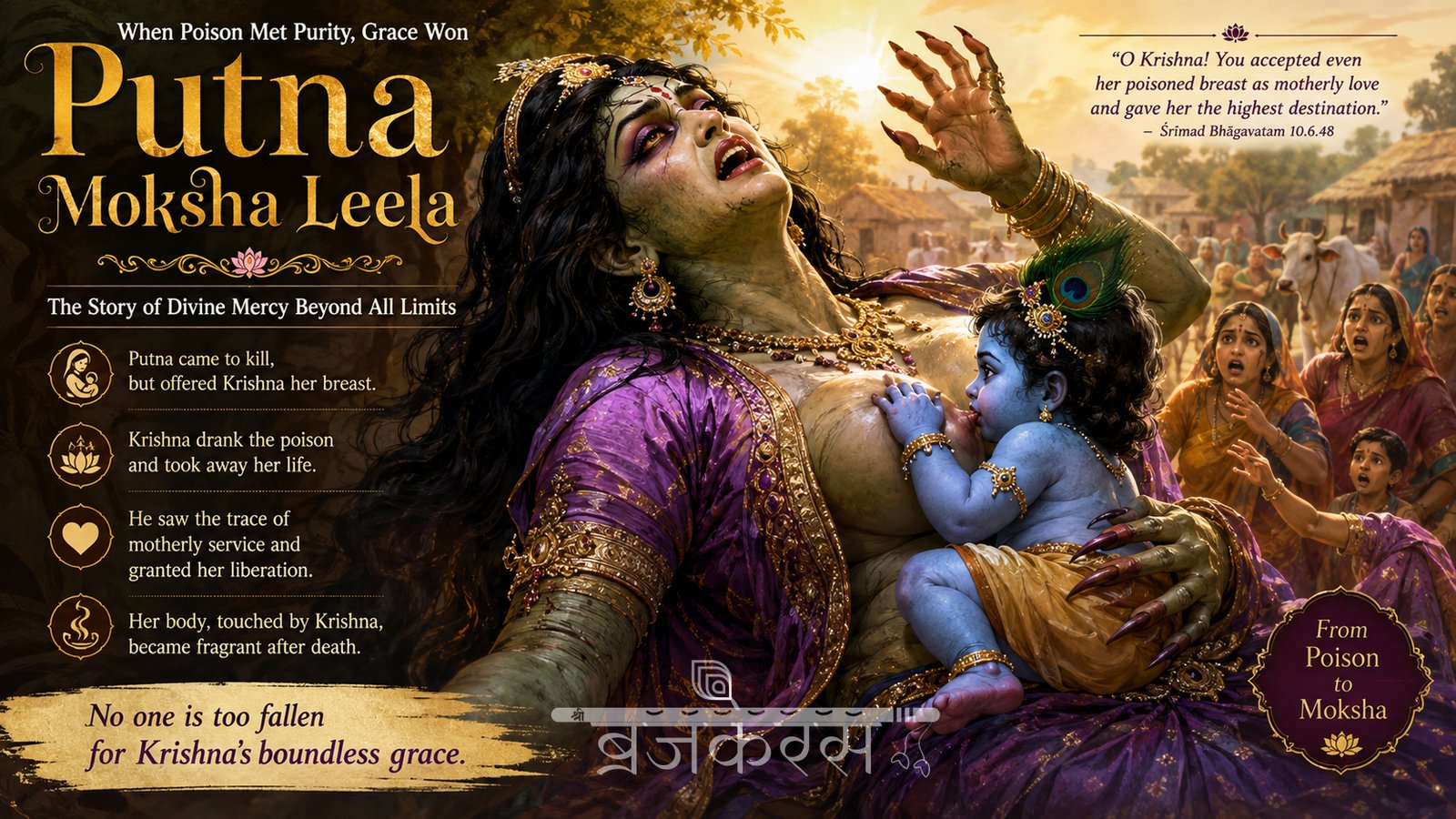
    Putna comes to take Krishna’s life, but Krishna takes away something far deeper: her poison, her wickedness, her accumulated sins and, finally, the bondage that held her.

    The killer receives liberation.

    It sounds almost unfair.

    And perhaps that is exactly why Putna Moksha Leela remains one of the most powerful early stories of Krishna’s life.

    Who Was Putna?

    ऐसा कृपा लुटाने वाला तुमसा कोई और नहीं | पूतना माता का स्वागत करना है |श्री कृष्णा | गीत संवाद

    Putna was a fearsome Rakshasi sent by King Kansa.

    Kansa had already heard the prophecy that Devaki’s eighth child would become the cause of his death. Fear took control of him. From that point, every newborn child seemed like a possible threat.

    This is what fear can do to power.

    A ruler who spends his life protecting his throne can eventually become a prisoner of that throne.

    After learning that the divine child had escaped his immediate reach, Kansa ordered his servants to search the surrounding regions and kill newborn babies. Putna became one of his deadliest agents.

    She possessed extraordinary powers. She could move from place to place, change her appearance, and conceal her terrifying form.

    Her method was especially cruel.

    Putna would approach infants as a caring woman, take them into her arms, and feed them poisoned milk.

    The image is disturbing for a reason.

    Something associated with motherhood and nourishment had been turned into a weapon.

    Then she came to Gokul.

    And Gokul was unlike any place she had entered before.

    Gokul Was Going About Its Day

    Day 1 – Putna Moksha Katha | LalGovindDas

    Imagine the setting for a moment.

    Cows moving through dusty lanes. The sound of bells around their necks. Children playing near the homes. Women busy with milk, butter, and household work. Nanda Baba’s home filled with the warmth that follows the arrival of a child.

    Baby Krishna was there.

    To the people of Braj, he was their beloved little Kanha.

    They didn’t sit around discussing cosmic theology every morning. Maa Yashoda wasn’t looking into the cradle thinking, “Here lies the Supreme Personality who governs creation.”

    She saw her son.

    That simple relationship matters.

    Braj Bhakti carries an intimacy that can feel almost startling. God isn’t kept at a ceremonial distance. He can be fed, hugged, scolded, dressed, protected and worried over.

    Then Putna entered this tender setting.

    She changed her appearance into that of an exceptionally beautiful woman. Her presence was so striking that people were unable to recognise the danger.

    She looked auspicious.

    She carried poison.

    There’s a sharp lesson hiding there already: appearance and intention don’t always travel together.

    But the story doesn’t stop at that fairly obvious moral. Krishna Leela rarely does.

    Shri Krishn & Putana Leela [4k] – Prem Mandir, Vrindavan

    Putna Walks Straight Up to Baby Krishna

    Putna entered Nanda Baba’s home and approached the infant, Krishna.

    The child before her appeared helpless.

    Small hands. Tiny feet. A baby lying peacefully before a demoness who had killed children before.

    What threat could such a child possibly pose?

    Putna lifted Krishna into her arms.

    Think about how strange this moment is.

    Kansa fears Krishna.

    Putna wants to murder Krishna.

    Yet she is allowed to hold him.

    The one whom yogis seek through years of spiritual discipline is resting in the arms of someone who has arrived with poison.

    Putna had smeared deadly poison upon her breast. She placed baby Krishna there, expecting the poison to end his life.

    Krishna began to drink.

    Then everything changed.

    Krishna Didn’t Stop at the Milk

    Putna expected Krishna to drink poisoned milk.

    Krishna drank far more.

    According to the Śrīmad Bhāgavatam, he sucked away the poison and her very life.

    Putna suddenly felt unbearable pain.

    The gentle disguise could no longer hold.

    She screamed.

    Her true demonic form emerged as she tried desperately to free herself from the child. Yet Krishna held firmly.

    The tiny baby she had expected to kill had become impossible to escape.

    Her cries shook the surrounding area.

    Then Putna fell.

    Her enormous body crashed across the land, revealing the monstrous form that had been hidden beneath her beautiful appearance.

    The people of Gokul were terrified.

    And there, upon her body, was Krishna.

    Safe.

    Still a child.

    You can almost imagine the panic that must have followed. The Gopis rushed to him. Maa Yashoda and Rohini were concerned for his protection. Traditional descriptions tell of protective rites being performed around Krishna with sacred names and cow-related substances, reflecting the pastoral religious life of Braj.

    From their point of view, their little Kanha had somehow survived a horrifying attack.

    From Krishna’s point of view?

    The matter was already settled.

    Putna had come with poison.

    He had accepted her service and removed her life.

    Yet the greatest surprise was still to come.

    Why Is It Called Putna Moksha Leela?

    श्री कृष्ण ने पूतना नाम की राक्षसी का कैसे किया वध ? Yashomati Maiyaa Ke Nandlala

    This is where the story moves from frightening folklore into profound Bhakti philosophy.

    Krishna didn’t simply kill Putna.

    He granted her an extraordinary spiritual destination.

    That raises an obvious question.

    Why?

    She wasn’t a devotee arriving with flowers.

    She didn’t come chanting Krishna’s name.

    She didn’t approach him with love.

    She came to murder him.

    Yet she performed one action that resembled the service of a mother: she placed Krishna at her breast and fed him.

    Her intention was false.

    The gesture carried poison.

    Krishna still accepted the maternal aspect of what she offered.

    The Śrīmad Bhāgavatam presents this event with great wonder. Putna, though wicked and murderous, received a position associated with Krishna’s motherly attendants after offering her breast to him.

    That idea can stop a reader in their tracks.

    If Krishna could give such grace to Putna, what might he give someone who approaches him with genuine affection?

    That question has echoed through Vaishnava traditions for centuries.

    Wait—Did Krishna Reward Evil?

    At first glance, it might sound that way.

    But Putna Moksha Leela isn’t saying that harmful actions don’t matter.

    Putna’s attack failed. Her poisonous intention was destroyed. She couldn’t remain as she was and simply collect a spiritual reward.

    Krishna consumed what she brought.

    Milk.

    Poison.

    And life itself.

    Her contact with him purified what was impure.

    That distinction matters.

    Divine grace doesn’t make poison good. It removes the poison.

    Putna arrived as a killer and didn’t leave as a victorious killer. The identity built around violence came to an end.

    Krishna saw something beyond it.

    A distorted imitation of motherhood had been offered to him, and he responded to the trace of maternal service within that act.

    There’s something almost unsettling about such mercy. Human beings tend to calculate.

    Who deserves what?

    How much good cancels how much bad?

    Who has earned forgiveness?

    Who hasn’t?

    Krishna’s grace doesn’t fit neatly inside that accounting sheet.

    The Fragrance After Putna’s Death

    One detail from the Putna episode is easy to miss, yet it carries enormous meaning.

    After Putna’s huge body fell, the people of Braj cut it into pieces and burned it.

    One might expect the burning body of a Rakshasi to produce a foul smell.

    Instead, the Bhāgavatam describes a pleasant fragrance arising from the smoke.

    Why?

    Her body had been touched by Krishna.

    This small detail changes the emotional colour of the scene.

    Putna entered carrying death. Her body had become an instrument for killing infants. Yet contact with Krishna purified even that body.

    The smoke rising from her funeral pyre became fragrant.

    Poison entered Gokul.

    Fragrance remained.

    That’s quite an ending.

    Maa Yashoda’s Side of the Story Matters Too

    It’s easy to become absorbed in Putna’s liberation and miss another beautiful layer of this Leela: Yashoda’s love.

    Krishna had defeated a terrifying demoness.

    Did Maa Yashoda congratulate him?

    Of course not.

    He was her baby.

    She worried that something terrible had happened to him.

    This is one of the sweetest paradoxes of Braj.

    Krishna protects creation, yet Yashoda believes she must protect Krishna.

    The Supreme Lord becomes dependent upon a mother’s embrace.

    Devotees have long cherished this mood because it changes the emotional distance between the human and divine.

    There is reverence, yes.

    But there is affection too.

    Deep, ordinary, domestic affection.

    The kind that checks if a child has eaten.

    The kind that worries after a loud noise.

    The kind that picks him up first and asks questions later.

    Putna arrives with supernatural powers, yet Yashoda’s simple motherly love holds a place she could never imitate.

    And that brings us to an important distinction.

    Putna Imitated Motherhood; Yashoda Lived It

    Putna’s outer action resembled maternal care.

    Her inner intention was murder.

    Yashoda’s motherhood came from genuine Vatsalya—deep parental affection for Krishna.

    Krishna recognised both.

    He accepted the tiny fragment of motherly service present in Putna’s act and gave her a result far beyond what she deserved. Yet the loving relationship enjoyed by Yashoda belongs to another order entirely.

    Grace is generous, but love has depth.

    Putna touched Krishna once with deception.

    Yashoda spent her days feeding him, bathing him, dressing him, chasing him, and worrying about him.

    One received liberation.

    The other received Krishna as her child.

    That contrast says plenty.

    What Putna Represents Inside Us

    Traditional Leela can be read as sacred history and still speak directly to ordinary human behaviour.

    Putna hides poison beneath beauty.

    We may not be wandering through villages disguised as demonesses, thankfully, but the pattern isn’t completely alien.

    Sometimes ego hides beneath politeness.

    Control hides beneath concern.

    Jealousy dresses itself as criticism “for your own good.”

    Pride can even hide inside spiritual practice.

    That last one stings a little.

    We’re remarkably good at making inner poison look respectable.

    Putna Moksha Leela asks us to look beneath presentation.

    What are we actually carrying when we approach Krishna?

    Love?

    Fear?

    A bargain?

    A request?

    Anger?

    Confusion?

    Maybe a mixture of everything.

    The comforting part of the Leela is that Krishna isn’t fooled by the packaging.

    Putna’s beauty couldn’t hide her poison from him.

    Yet her poison couldn’t stop his grace either.

    Krishna Takes the Poison

    There is another way devotees often contemplate this episode.

    Putna gives Krishna poison, and Krishna takes it from her.

    He doesn’t become poisoned.

    She becomes free from it.

    That pattern appears again and again in devotional thought. We approach the divine carrying things we’d rather not admit are there—anger, greed, resentment, insecurity, pride.

    Bhakti doesn’t begin after a person becomes flawless.

    If perfection were the entry ticket, the queue would be rather empty.

    One begins where one is.

    Putna is an extreme example, of course. That extremity makes the message impossible to miss.

    If Krishna could accept something from her, no sincere person needs to think, “I’m too impure to approach him.”

    Approach first.

    Let purification follow.

    Why Putna Moksha Leela Still Feels So Powerful

    Thousands of years after these stories were preserved in sacred literature, Putna’s episode still catches attention.

    Partly because it’s dramatic.

    A shape-shifting demoness. A poisoned breast. An infant who turns out to be the master of life and death. A gigantic body falling outside the settlement.

    It has all the ingredients of an unforgettable story.

    But spectacle isn’t what keeps devotees returning to it.

    Mercy does.

    Putna represents perhaps one of the least deserving people imaginable. She targets infants. She disguises murder as nourishment. She approaches Krishna without surrender.

    And Krishna finds a reason to give grace.

    A tiny reason, perhaps.

    But for Krishna, it is enough.

    That reverses the way many of us instinctively think about spirituality.

    We often imagine God searching for reasons to reject us.

    Putna Moksha Leela presents Krishna searching for something he can accept.

    What Can We Learn From Putna Moksha Leela?

    Several reflections naturally rise from this story:

    • Outer beauty can hide harmful intent. Putna looked divine, yet carried poison.
    • Contact with Krishna purifies. Even Putna’s body became sanctified after touching him.
    • No sincere approach is insignificant. Krishna recognised a maternal gesture inside an act filled with deception.
    • Bhakti begins before perfection. A person doesn’t need to clean every corner of the heart before remembering Krishna.
    • Divine grace can exceed human calculations. Putna’s destination cannot be explained through ordinary ideas of reward and punishment alone.
    • Genuine love remains incomparable. Putna imitated motherhood for a moment; Yashoda offered Krishna the spontaneous affection of a mother every day.

    And perhaps there’s one lesson beneath all the others.

    Never underestimate Krishna’s willingness to accept the smallest trace of relationship.

    From Poison to Grace

    Putna entered Gokul thinking she had found another helpless infant.

    She saw a child.

    She missed the infinite.

    Her poison couldn’t harm Krishna. Her disguise couldn’t deceive him. Her strength couldn’t save her.

    Yet her contact with him wasn’t wasted.

    The woman who came as death received freedom.

    The breast prepared as a weapon became, through Krishna’s acceptance, the reason commentators remember her in connection with maternal service.

    The body that carried poison produced fragrant smoke after touching him.

    Nothing about Putna deserved such an ending.

    That’s precisely the point.

    Krishna’s mercy isn’t small.

    Putna Moksha Leela leaves us with an unusual kind of hope. We don’t need to pretend that darkness is light. Putna’s actions were terrible. The story never asks us to soften that fact.

    Instead, it asks a far more interesting question:

    Can divine grace reach someone even there?

    Krishna’s answer is yes.

    So the next time we remember baby Krishna lying peacefully in Gokul, we might remember something beyond the charming image of little Kanha.

    This tiny child could drink poison without being harmed.

    He could see through deception without rejecting the person forever.

    And where everyone else saw a terrifying demoness, Krishna found one small act he could accept.

    That is Putna Moksha Leela.

    A story that begins with poison.

    And somehow ends with grace.

  • Makhan Chori Leela

    Makhan Chori Leela

    The Sweet Mischief of Little Krishna

    Makhan Chori Leela is one of the most loving and playful pastimes of Lord Krishna during His childhood in Gokul.

    As a young boy, Krishna was famous for stealing butter (makhan) from the homes of the Gopis, often with His close friends.


    🌿 The Story

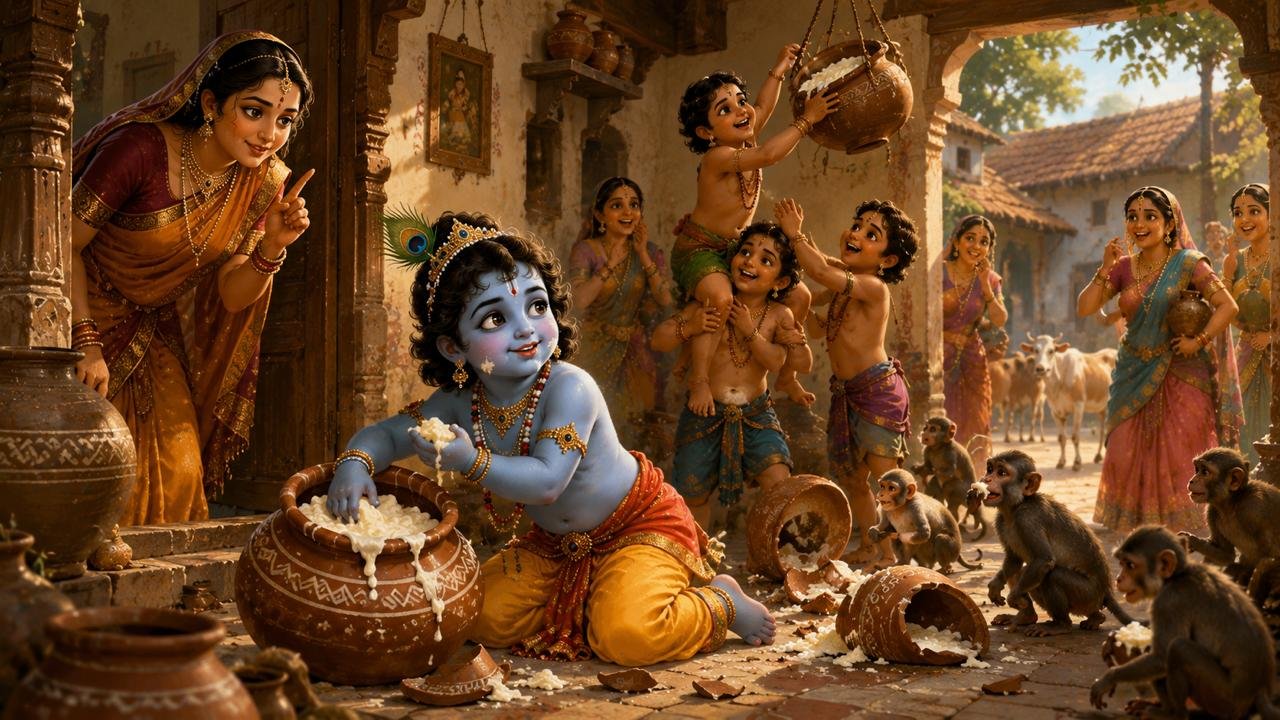
    In the village of Gokul, the Gopis churned fresh butter daily and stored it carefully—often high above in pots to keep it away from little Krishna. But nothing could stop Him!

    Krishna, along with the Gwaal Bal (cowherd friends), would:

    • Sneak into homes when no one was watching
    • Climb on each other’s shoulders to reach the butter pots
    • Break the pots and share the butter happily
    • Feed some to monkeys and laugh joyfully

    Even when caught, Krishna’s innocent smile would melt the hearts of the Gopis, making it impossible for them to stay angry.


    💛 Why Krishna Stole Butter

    Krishna did not need butter—He is the Lord of the universe. Yet He performed this leela to express love and joy.

    Spiritual Meaning:

    • Butter represents a pure heart (soft, clean, and full of love)
    • Krishna “steals” the hearts of those who love Him sincerely
    • God is attracted not by riches, but by innocent devotion (bhakti)

    👩‍👦 Yashoda’s Love

    Mother Yashoda would often hear complaints from the Gopis about Krishna’s mischievous acts. But when she saw His innocence and charm, her anger would turn into affection.

    This shows: 👉 Divine love between God and devotee as mother and child
    👉 God allows Himself to be controlled by pure love


    🌸 Lesson from Makhan Chori Leela

    • Keep your heart pure and simple
    • Love God with innocence and joy
    • Share happiness with others
    • True devotion attracts divine presence

    Makhan Chori Leela Bhajan

    “Makhan Chori Kanhaiya”

    Makhan chori Kanhaiya kare,
    Natkhat muskaan se mann hare
    Matki phode hans hans jaaye,
    Prem se sabko apna banaye. Chorus:
    Radhe Radhe japo re bhai,
    Shyam bina chain na aai