
Putna Moksha Leela: When Shri Krishna Gave Liberation to the Demoness Who Came to Kill Him
There are many moments in Shri Krishna’s childhood leelas that make us smile.
He steals butter. He crawls through the courtyards of Gokul. He charms the Gopis. He troubles Maa Yashoda and then looks at her with such innocence that punishment almost feels impossible.
Putna Moksha Leela begins very differently.
A woman enters Gokul carrying death.
She looks beautiful. Gentle. Almost divine. No one sees the danger hidden beneath her appearance. She has come for one reason—to kill the infant Krishna.
Yet something astonishing happens.
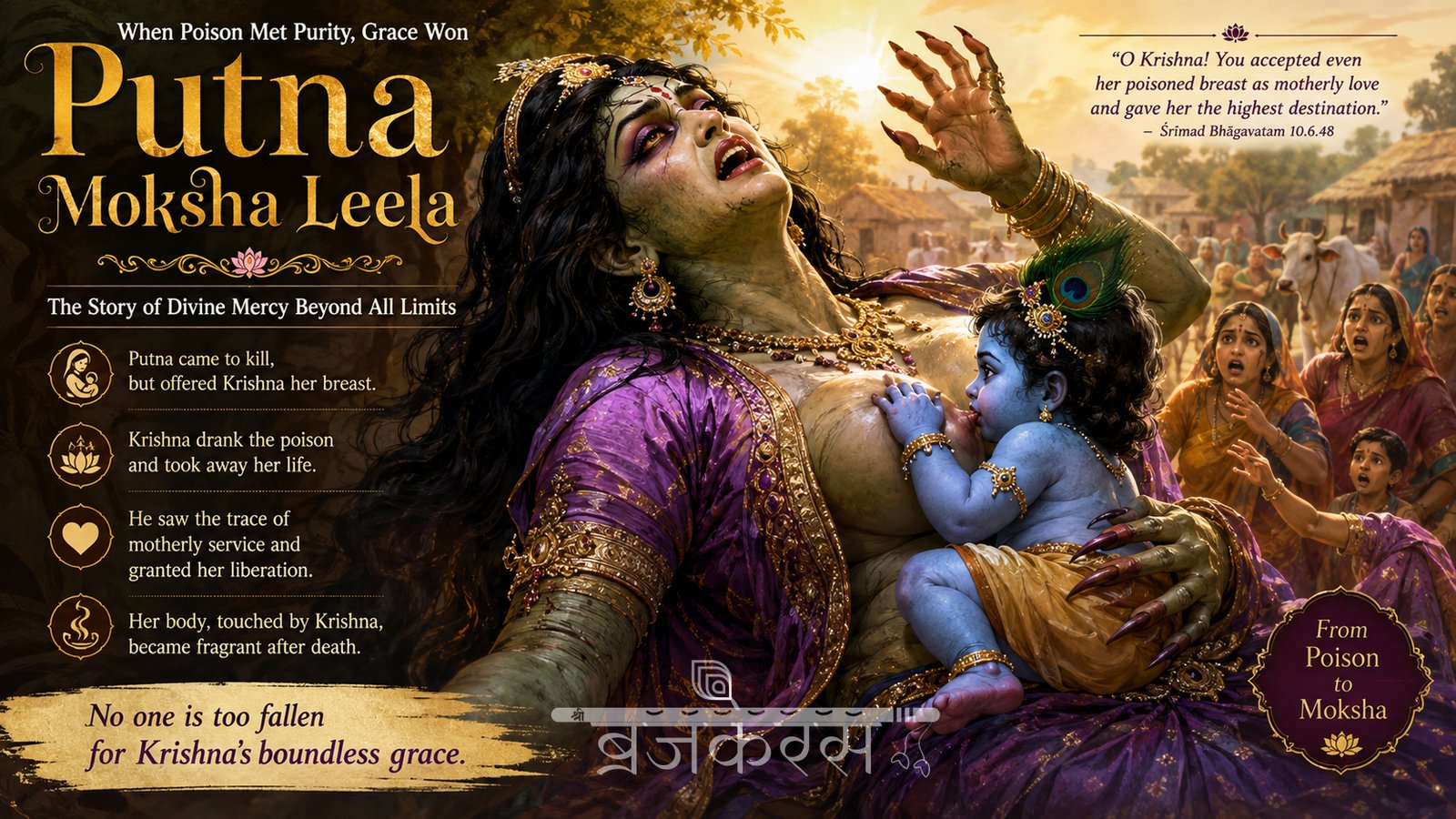
Putna comes to take Krishna’s life, but Krishna takes away something far deeper: her poison, her wickedness, her accumulated sins and, finally, the bondage that held her.
The killer receives liberation.
It sounds almost unfair.
And perhaps that is exactly why Putna Moksha Leela remains one of the most powerful early stories of Krishna’s life.
Who Was Putna?
Putna was a fearsome Rakshasi sent by King Kansa.
Kansa had already heard the prophecy that Devaki’s eighth child would become the cause of his death. Fear took control of him. From that point, every newborn child seemed like a possible threat.
This is what fear can do to power.
A ruler who spends his life protecting his throne can eventually become a prisoner of that throne.
After learning that the divine child had escaped his immediate reach, Kansa ordered his servants to search the surrounding regions and kill newborn babies. Putna became one of his deadliest agents.
She possessed extraordinary powers. She could move from place to place, change her appearance, and conceal her terrifying form.
Her method was especially cruel.
Putna would approach infants as a caring woman, take them into her arms, and feed them poisoned milk.
The image is disturbing for a reason.
Something associated with motherhood and nourishment had been turned into a weapon.
Then she came to Gokul.
And Gokul was unlike any place she had entered before.
Gokul Was Going About Its Day
Imagine the setting for a moment.
Cows moving through dusty lanes. The sound of bells around their necks. Children playing near the homes. Women busy with milk, butter, and household work. Nanda Baba’s home filled with the warmth that follows the arrival of a child.
Baby Krishna was there.
To the people of Braj, he was their beloved little Kanha.
They didn’t sit around discussing cosmic theology every morning. Maa Yashoda wasn’t looking into the cradle thinking, “Here lies the Supreme Personality who governs creation.”
She saw her son.
That simple relationship matters.
Braj Bhakti carries an intimacy that can feel almost startling. God isn’t kept at a ceremonial distance. He can be fed, hugged, scolded, dressed, protected and worried over.
Then Putna entered this tender setting.
She changed her appearance into that of an exceptionally beautiful woman. Her presence was so striking that people were unable to recognise the danger.
She looked auspicious.
She carried poison.
There’s a sharp lesson hiding there already: appearance and intention don’t always travel together.
But the story doesn’t stop at that fairly obvious moral. Krishna Leela rarely does.
Putna Walks Straight Up to Baby Krishna
Putna entered Nanda Baba’s home and approached the infant, Krishna.
The child before her appeared helpless.
Small hands. Tiny feet. A baby lying peacefully before a demoness who had killed children before.
What threat could such a child possibly pose?
Putna lifted Krishna into her arms.
Think about how strange this moment is.
Kansa fears Krishna.
Putna wants to murder Krishna.
Yet she is allowed to hold him.
The one whom yogis seek through years of spiritual discipline is resting in the arms of someone who has arrived with poison.
Putna had smeared deadly poison upon her breast. She placed baby Krishna there, expecting the poison to end his life.
Krishna began to drink.
Then everything changed.
Krishna Didn’t Stop at the Milk
Putna expected Krishna to drink poisoned milk.
Krishna drank far more.
According to the Śrīmad Bhāgavatam, he sucked away the poison and her very life.
Putna suddenly felt unbearable pain.
The gentle disguise could no longer hold.
She screamed.
Her true demonic form emerged as she tried desperately to free herself from the child. Yet Krishna held firmly.
The tiny baby she had expected to kill had become impossible to escape.
Her cries shook the surrounding area.
Then Putna fell.
Her enormous body crashed across the land, revealing the monstrous form that had been hidden beneath her beautiful appearance.
The people of Gokul were terrified.
And there, upon her body, was Krishna.
Safe.
Still a child.
You can almost imagine the panic that must have followed. The Gopis rushed to him. Maa Yashoda and Rohini were concerned for his protection. Traditional descriptions tell of protective rites being performed around Krishna with sacred names and cow-related substances, reflecting the pastoral religious life of Braj.
From their point of view, their little Kanha had somehow survived a horrifying attack.
From Krishna’s point of view?
The matter was already settled.
Putna had come with poison.
He had accepted her service and removed her life.
Yet the greatest surprise was still to come.
Why Is It Called Putna Moksha Leela?
This is where the story moves from frightening folklore into profound Bhakti philosophy.
Krishna didn’t simply kill Putna.
He granted her an extraordinary spiritual destination.
That raises an obvious question.
Why?
She wasn’t a devotee arriving with flowers.
She didn’t come chanting Krishna’s name.
She didn’t approach him with love.
She came to murder him.
Yet she performed one action that resembled the service of a mother: she placed Krishna at her breast and fed him.
Her intention was false.
The gesture carried poison.
Krishna still accepted the maternal aspect of what she offered.
The Śrīmad Bhāgavatam presents this event with great wonder. Putna, though wicked and murderous, received a position associated with Krishna’s motherly attendants after offering her breast to him.
That idea can stop a reader in their tracks.
If Krishna could give such grace to Putna, what might he give someone who approaches him with genuine affection?
That question has echoed through Vaishnava traditions for centuries.
Wait—Did Krishna Reward Evil?
At first glance, it might sound that way.
But Putna Moksha Leela isn’t saying that harmful actions don’t matter.
Putna’s attack failed. Her poisonous intention was destroyed. She couldn’t remain as she was and simply collect a spiritual reward.
Krishna consumed what she brought.
Milk.
Poison.
And life itself.
Her contact with him purified what was impure.
That distinction matters.
Divine grace doesn’t make poison good. It removes the poison.
Putna arrived as a killer and didn’t leave as a victorious killer. The identity built around violence came to an end.
Krishna saw something beyond it.
A distorted imitation of motherhood had been offered to him, and he responded to the trace of maternal service within that act.
There’s something almost unsettling about such mercy. Human beings tend to calculate.
Who deserves what?
How much good cancels how much bad?
Who has earned forgiveness?
Who hasn’t?
Krishna’s grace doesn’t fit neatly inside that accounting sheet.
The Fragrance After Putna’s Death
One detail from the Putna episode is easy to miss, yet it carries enormous meaning.
After Putna’s huge body fell, the people of Braj cut it into pieces and burned it.
One might expect the burning body of a Rakshasi to produce a foul smell.
Instead, the Bhāgavatam describes a pleasant fragrance arising from the smoke.
Why?
Her body had been touched by Krishna.
This small detail changes the emotional colour of the scene.
Putna entered carrying death. Her body had become an instrument for killing infants. Yet contact with Krishna purified even that body.
The smoke rising from her funeral pyre became fragrant.
Poison entered Gokul.
Fragrance remained.
That’s quite an ending.
Maa Yashoda’s Side of the Story Matters Too
It’s easy to become absorbed in Putna’s liberation and miss another beautiful layer of this Leela: Yashoda’s love.
Krishna had defeated a terrifying demoness.
Did Maa Yashoda congratulate him?
Of course not.
He was her baby.
She worried that something terrible had happened to him.
This is one of the sweetest paradoxes of Braj.
Krishna protects creation, yet Yashoda believes she must protect Krishna.
The Supreme Lord becomes dependent upon a mother’s embrace.
Devotees have long cherished this mood because it changes the emotional distance between the human and divine.
There is reverence, yes.
But there is affection too.
Deep, ordinary, domestic affection.
The kind that checks if a child has eaten.
The kind that worries after a loud noise.
The kind that picks him up first and asks questions later.
Putna arrives with supernatural powers, yet Yashoda’s simple motherly love holds a place she could never imitate.
And that brings us to an important distinction.
Putna Imitated Motherhood; Yashoda Lived It
Putna’s outer action resembled maternal care.
Her inner intention was murder.
Yashoda’s motherhood came from genuine Vatsalya—deep parental affection for Krishna.
Krishna recognised both.
He accepted the tiny fragment of motherly service present in Putna’s act and gave her a result far beyond what she deserved. Yet the loving relationship enjoyed by Yashoda belongs to another order entirely.
Grace is generous, but love has depth.
Putna touched Krishna once with deception.
Yashoda spent her days feeding him, bathing him, dressing him, chasing him, and worrying about him.
One received liberation.
The other received Krishna as her child.
That contrast says plenty.
What Putna Represents Inside Us
Traditional Leela can be read as sacred history and still speak directly to ordinary human behaviour.
Putna hides poison beneath beauty.
We may not be wandering through villages disguised as demonesses, thankfully, but the pattern isn’t completely alien.
Sometimes ego hides beneath politeness.
Control hides beneath concern.
Jealousy dresses itself as criticism “for your own good.”
Pride can even hide inside spiritual practice.
That last one stings a little.
We’re remarkably good at making inner poison look respectable.
Putna Moksha Leela asks us to look beneath presentation.
What are we actually carrying when we approach Krishna?
Love?
Fear?
A bargain?
A request?
Anger?
Confusion?
Maybe a mixture of everything.
The comforting part of the Leela is that Krishna isn’t fooled by the packaging.
Putna’s beauty couldn’t hide her poison from him.
Yet her poison couldn’t stop his grace either.
Krishna Takes the Poison
There is another way devotees often contemplate this episode.
Putna gives Krishna poison, and Krishna takes it from her.
He doesn’t become poisoned.
She becomes free from it.
That pattern appears again and again in devotional thought. We approach the divine carrying things we’d rather not admit are there—anger, greed, resentment, insecurity, pride.
Bhakti doesn’t begin after a person becomes flawless.
If perfection were the entry ticket, the queue would be rather empty.
One begins where one is.
Putna is an extreme example, of course. That extremity makes the message impossible to miss.
If Krishna could accept something from her, no sincere person needs to think, “I’m too impure to approach him.”
Approach first.
Let purification follow.
Why Putna Moksha Leela Still Feels So Powerful
Thousands of years after these stories were preserved in sacred literature, Putna’s episode still catches attention.
Partly because it’s dramatic.
A shape-shifting demoness. A poisoned breast. An infant who turns out to be the master of life and death. A gigantic body falling outside the settlement.
It has all the ingredients of an unforgettable story.
But spectacle isn’t what keeps devotees returning to it.
Mercy does.
Putna represents perhaps one of the least deserving people imaginable. She targets infants. She disguises murder as nourishment. She approaches Krishna without surrender.
And Krishna finds a reason to give grace.
A tiny reason, perhaps.
But for Krishna, it is enough.
That reverses the way many of us instinctively think about spirituality.
We often imagine God searching for reasons to reject us.
Putna Moksha Leela presents Krishna searching for something he can accept.
What Can We Learn From Putna Moksha Leela?
Several reflections naturally rise from this story:
- Outer beauty can hide harmful intent. Putna looked divine, yet carried poison.
- Contact with Krishna purifies. Even Putna’s body became sanctified after touching him.
- No sincere approach is insignificant. Krishna recognised a maternal gesture inside an act filled with deception.
- Bhakti begins before perfection. A person doesn’t need to clean every corner of the heart before remembering Krishna.
- Divine grace can exceed human calculations. Putna’s destination cannot be explained through ordinary ideas of reward and punishment alone.
- Genuine love remains incomparable. Putna imitated motherhood for a moment; Yashoda offered Krishna the spontaneous affection of a mother every day.
And perhaps there’s one lesson beneath all the others.
Never underestimate Krishna’s willingness to accept the smallest trace of relationship.
From Poison to Grace
Putna entered Gokul thinking she had found another helpless infant.
She saw a child.
She missed the infinite.
Her poison couldn’t harm Krishna. Her disguise couldn’t deceive him. Her strength couldn’t save her.
Yet her contact with him wasn’t wasted.
The woman who came as death received freedom.
The breast prepared as a weapon became, through Krishna’s acceptance, the reason commentators remember her in connection with maternal service.
The body that carried poison produced fragrant smoke after touching him.
Nothing about Putna deserved such an ending.
That’s precisely the point.
Krishna’s mercy isn’t small.
Putna Moksha Leela leaves us with an unusual kind of hope. We don’t need to pretend that darkness is light. Putna’s actions were terrible. The story never asks us to soften that fact.
Instead, it asks a far more interesting question:
Can divine grace reach someone even there?
Krishna’s answer is yes.
So the next time we remember baby Krishna lying peacefully in Gokul, we might remember something beyond the charming image of little Kanha.
This tiny child could drink poison without being harmed.
He could see through deception without rejecting the person forever.
And where everyone else saw a terrifying demoness, Krishna found one small act he could accept.
That is Putna Moksha Leela.
A story that begins with poison.
And somehow ends with grace.