
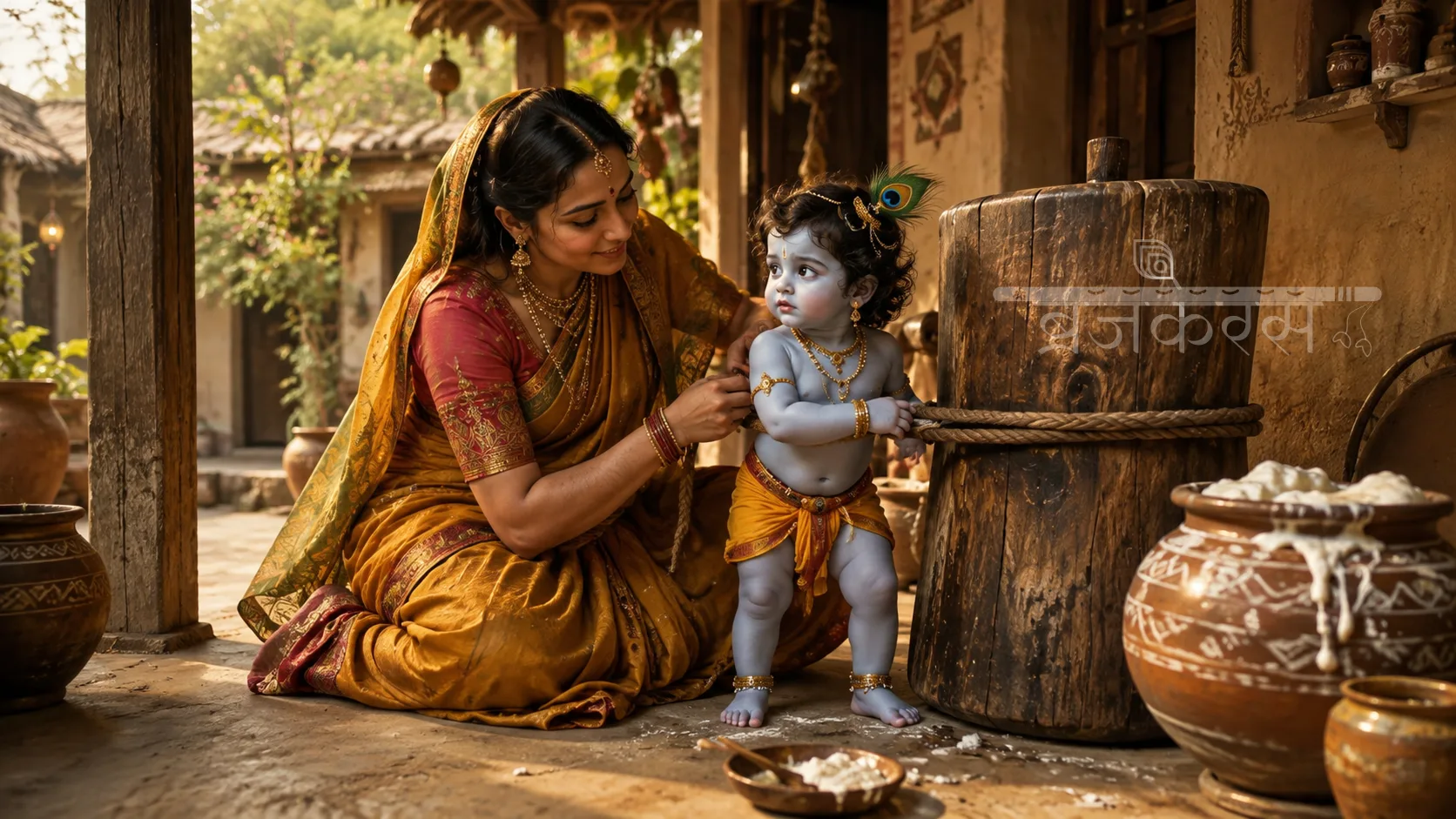
Damodar Leela tells how Maa Yashoda chased mischievous Krishna and tied him to a mortar. Her rope kept falling short until Krishna lovingly allowed his mother to bind him.
Can God be tied with a piece of rope?
It sounds impossible.
How could the one who holds countless universes within himself be restrained by a village mother? How could the Supreme Lord, whom sages seek through meditation and prayer, stand frightened before Maa Yashoda with tears in his eyes?
Yet this is exactly what happens in Damodar Leela, one of the sweetest childhood Leelas of Shri Krishna.
There is no battlefield here.
No terrifying demon arrives.
No great weapon appears.
The setting is wonderfully ordinary: a mother, a mischievous child, a broken pot of curd, stolen butter, a wooden grinding mortar, and a rope that somehow refuses to become long enough.
Then something remarkable happens.
Maa Yashoda binds Krishna.
Or perhaps Krishna allows himself to be bound.
That small distinction carries the whole beauty of the Leela.
It Begins With Yashoda Churning Curd
The Śrīmad Bhāgavatam places us inside the household of Nanda Baba in Gokul.
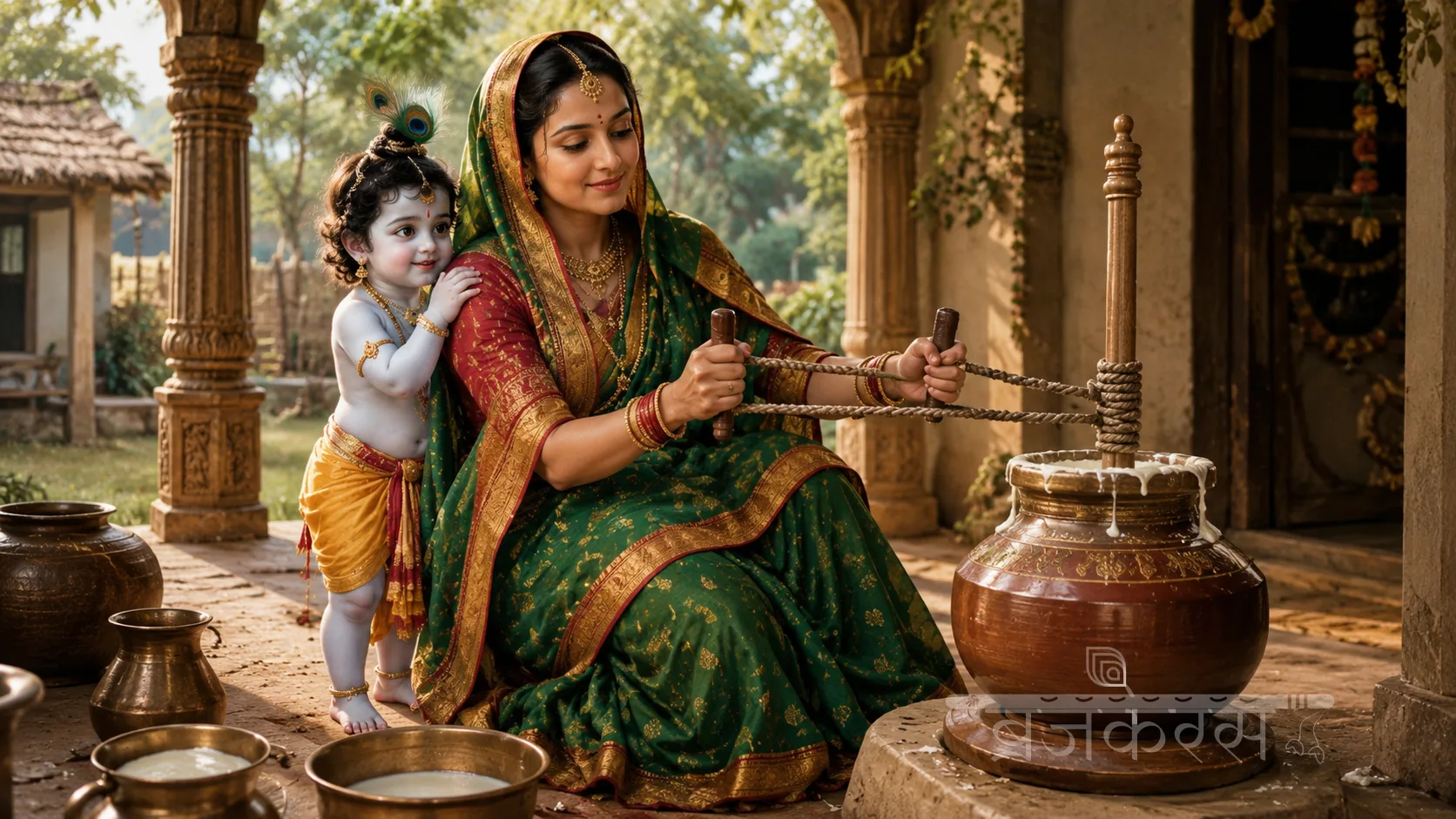
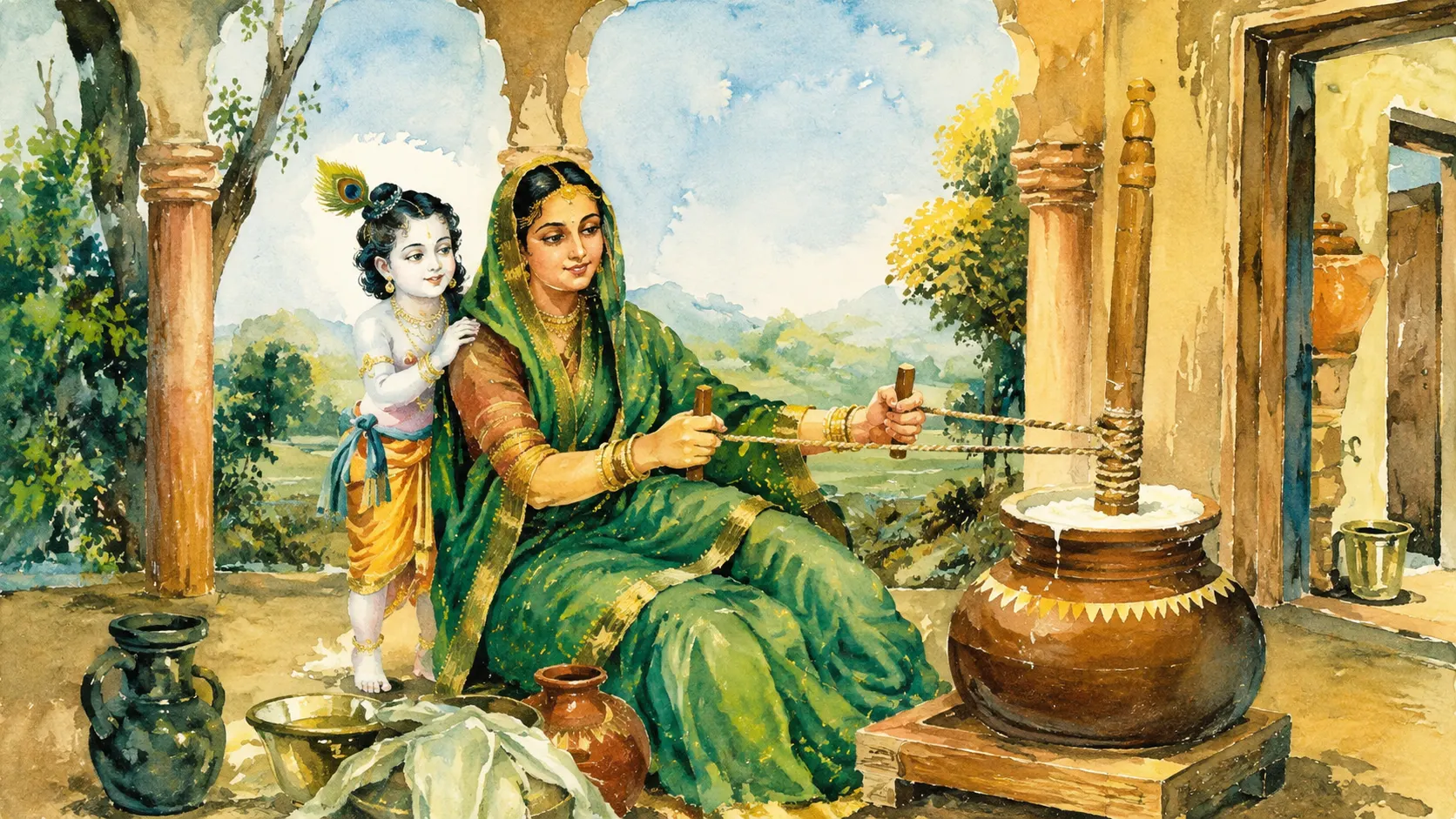
Early one morning, Maa Yashoda is churning curd.
Picture the scene.
The rhythmic sound of the churning rope fills the home. Her bangles move against one another. She sings about Krishna’s childhood activities as she works.
There is something deeply Braj-like about this image.
Devotion isn’t separated from daily life.
Yashoda doesn’t need to leave her home to remember Krishna. She remembers him while making butter.
Work becomes remembrance.
Then little Krishna wakes up.
And he is hungry.
He approaches his mother and wants milk.
Right now.
Anyone who has spent time around a hungry toddler knows there isn’t much room for negotiation here.
Yashoda stops churning and takes Krishna into her lap.
She begins feeding him.
For a few peaceful moments, Kanha has exactly what he wants.
Then milk boiling on the stove begins to rise.
Yashoda notices.
She gently puts Krishna down and rushes to save the milk before it spills.
A sensible decision.
Krishna doesn’t agree.
Krishna Is Not Happy About Being Left Behind
Little Krishna becomes upset.
His mother had been feeding him.
Then she suddenly left.
From an adult point of view, Yashoda had a perfectly good reason. Milk was about to boil over.
From Krishna’s point of view?
Maa left me.
That’s enough.
His lips tremble with anger.
Then the butter thief gets an idea.
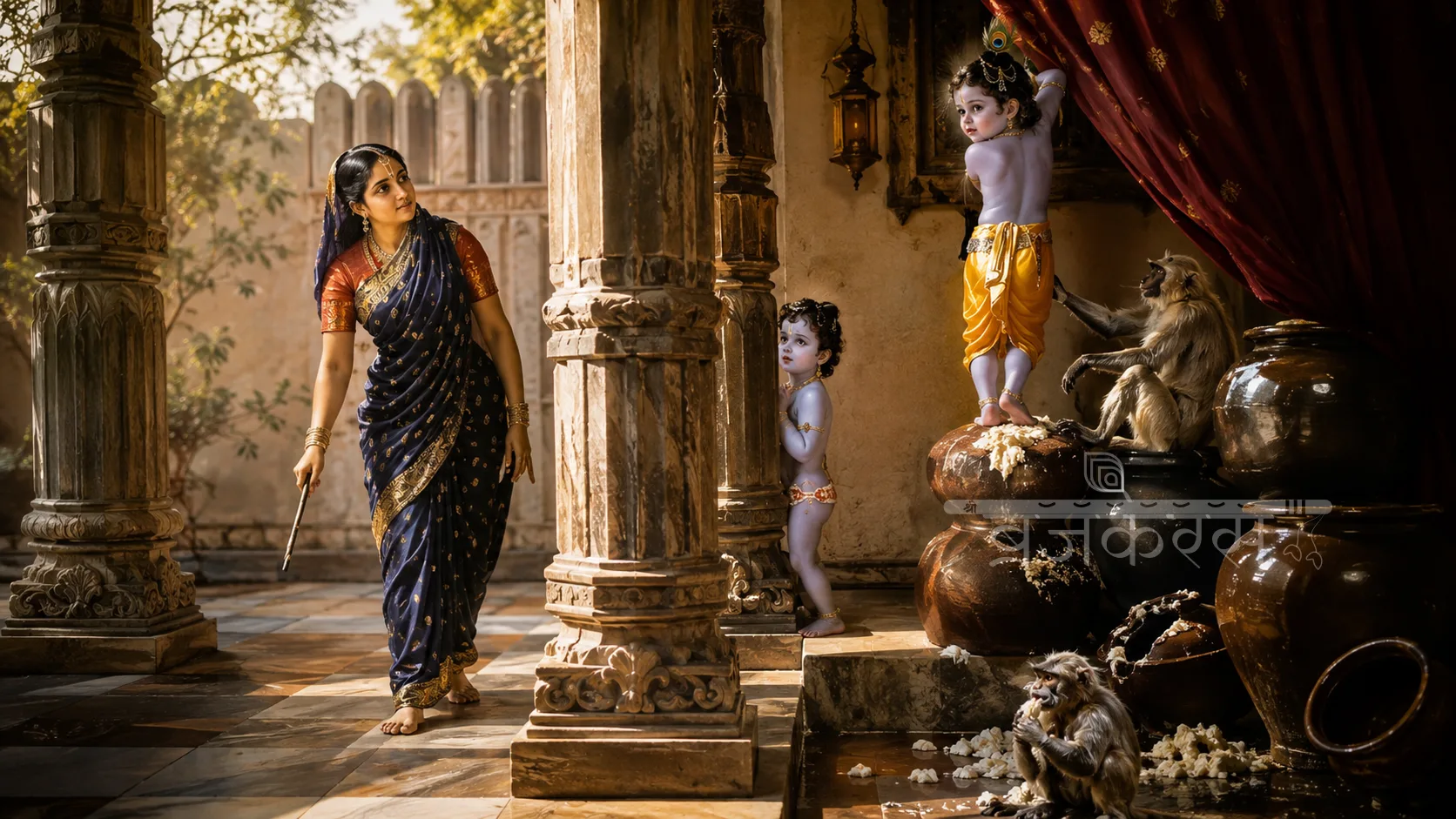
Krishna picks up a stone and breaks the pot of curd.
Yes, the Supreme Lord throws a tantrum.
This is part of the charm of Braj Bhakti. Krishna isn’t presented only through grandeur and divine authority. He becomes a child with moods, mischief, and a very clear opinion about interrupted meals.
After breaking the pot, Krishna goes elsewhere and begins eating freshly churned butter.
He doesn’t keep it all for himself either.
He feeds some to the monkeys.
There’s something wonderfully cheeky about the scene.
Yashoda had been working to make butter for the household.
Krishna becomes the unofficial distribution manager.
The monkeys are delighted.
Yashoda Discovers the Crime Scene
When Maa Yashoda returns, she sees the broken curd pot.
It doesn’t take Sherlock Holmes to work out what happened.
She knows her son.
Following the little clues, she finds Krishna sitting near an overturned wooden grinding mortar, eating butter and sharing it with monkeys.
Krishna keeps looking around nervously.
He knows he has been caught.
Yashoda approaches with a small stick in her hand.
Krishna sees her.
And runs.
Now comes one of the most loved scenes in Krishna’s childhood.
The Supreme Lord runs away from his mother.
Wait… Krishna Is Afraid?
Think about that for a moment.
Kansa fears Krishna.
Putna couldn’t survive his touch.
Trinavarta carried him into the sky and died when Krishna gripped his throat.
Yet the same Krishna runs when Yashoda approaches with a stick.
How?
The answer lies in the relationship.
Krishna isn’t afraid of Yashoda’s physical strength.
He responds to her love.
Braj turns ordinary spiritual hierarchy upside down.
The devotee bows before God.
Yet here God runs before his devotee.
Yashoda chases him through the courtyard.
Krishna is quick.
Yashoda isn’t exactly dressed for a sprint. She has been doing household work; her body is tired, flowers begin falling from her hair, and she struggles to keep pace.
Still, she doesn’t give up.
Eventually she catches him.
One can almost imagine Krishna looking back and thinking, “Ah. This has become serious.”
Tears in Krishna’s Eyes
When Yashoda catches Krishna, she sees him crying.
He rubs his eyes with his little hands.
The black kajal around them becomes smeared.
He looks frightened.
This image has been cherished by poets, saints, painters and devotees for centuries.
The fearless Lord is afraid of his mother.
Not fake fear.
Not a theatrical performance in the ordinary sense.
Within the sweetness of his Leela, Krishna accepts the emotional reality of being Yashoda’s child.
She sees her mischievous son.
She doesn’t see the ruler of creation standing before her.
That lack of divine distance is one of the defining features of Vatsalya Bhava—devotion expressed through parental love.
Yashoda decides she needs to stop Krishna from running off and causing more mischief.
So she tries to tie him to a wooden grinding mortar.
Simple enough.
Except the rope doesn’t fit.
The Rope Is Two Fingers Too Short
Yashoda takes a rope and wraps it around Krishna’s waist.
It is too short.
By how much?
Two fingers.
So she gets another piece of rope and ties it to the first.
She tries again.
Still two fingers short.
Another rope is added.
Still short.
More rope.
Same result.
At this point, the situation becomes wonderfully strange.
Krishna is a small child.
Yashoda has gathered plenty of rope.
Mathematically, this problem should have been solved several ropes ago.
Yet every attempt ends in the same way.
Two fingers short.
Shukadev Goswami tells King Parikshit:
न चान्तर्न बहिर्यस्य न पूर्वं नापि चापरम् ।
पूर्वापरं बहिश्चान्तर्जगतो यो जगच्च य: ॥
na chantar na bahir yasya na purvam napi chaparam
purvaparam bahish chantar jagato yo jagachcha yah
People from the household begin watching.
More rope is brought.
Yashoda joins piece after piece.
Still, Krishna cannot be bound.
The little boy’s waist hasn’t visibly grown.
The rope simply refuses to reach.
Why Was the Rope Always Two Fingers Short?
This detail has inspired a beautiful devotional interpretation.
Many Vaishnava teachers explain the two-finger gap as representing two elements in Bhakti:
One finger represents the devotee’s sincere effort, and the other represents Krishna’s grace.
Effort alone cannot bind Krishna.
Grace without loving engagement doesn’t describe Yashoda’s experience either.
Both meet.
Yashoda keeps trying.
She doesn’t throw the rope aside after the second attempt and say, “Well, apparently this isn’t meant to happen.”
She works.
She sweats.
She gathers more rope.
She persists out of love.
Krishna watches.
Then he sees that his mother is exhausted.
Her hair has loosened.
Her body is tired.
She has done everything she can.
Krishna’s heart softens.
And suddenly the rope fits.
Same Krishna.
Same mother.
Same task.
Something has changed.
Krishna has agreed to be bound.
You Cannot Force Krishna, But Love Can Hold Him
This is the centre of Damodar Leela.
Yashoda doesn’t overpower Krishna.
Krishna allows her love to overpower him.
The distinction is beautiful.
No amount of rope could bind the limitless Lord without his consent. Yashoda could have tied together every rope in Gokul and remained two fingers short.
Then Krishna sees her loving effort.
He gives himself.
Bhakti traditions return to this idea again and again: God may be infinite, yet loving devotion creates intimacy with him.
Knowledge can describe his greatness.
Meditation can contemplate him.
Ritual can honour him.
Love does something unexpectedly personal.
It makes Krishna belong to Yashoda.
Why Is Krishna Called Damodar?
The name Damodar comes from Sanskrit.
Dama refers to rope.
Udara means belly or abdomen.
Damodar, then, refers to the Lord whose belly was bound with a rope.
It’s an extraordinary divine name when you think about it.
Many names of God celebrate power, majesty, protection, or cosmic authority.
Damodar remembers the day God got caught stealing butter and his mother tied him up.
Only Braj could give us something quite like this.
The name preserves a relationship.
Whenever devotees say “Damodar,” they remember Krishna’s willingness to become subordinate to Yashoda’s affection.
That is why this Leela holds such a beloved place in Vaishnava devotion.
The Infinite Belly and a Village Rope
There is another beautiful paradox hidden in Krishna’s name.
Yashoda ties a rope around Krishna’s belly.
This is the same child whose mouth, in another famous Leela, reveals the cosmic creation to his mother.
Universes exist within him.
Yet a rope from Nanda Baba’s household goes around his waist.
How can both be true?
Krishna Leela doesn’t rush to flatten the contradiction.
It lets both truths sit together.
Krishna is infinite.
Krishna is Yashoda’s child.
His divinity doesn’t cancel his childhood intimacy.
His childhood doesn’t reduce his divinity.
This meeting of majesty and affection gives Braj Bhakti its particular sweetness.
The limitless becomes reachable.
Krishna Is Bound, but the Story Isn’t Finished
After tying Krishna to the wooden grinding mortar, Yashoda returns to her household duties.
One might expect Krishna to sit quietly and reconsider his life choices.
He doesn’t.
There are two tall Arjuna trees nearby.
These trees have a story of their own.
According to the Śrīmad Bhāgavatam, they were connected with Nalakuvara and Manigriva, sons of Kubera.
The two had become intoxicated by wealth and pleasure. The sage Narada encountered them and gave them a curse that was really a hidden blessing: they would take the form of trees until Krishna personally freed them.
Years passed.
They stood in Nanda Baba’s courtyard as twin Arjuna trees.
Then Damodar came crawling their way.
Still tied to the mortar.
Krishna Pulls the Mortar Between the Trees
Krishna begins dragging the heavy wooden mortar behind him.
He moves between the two Arjuna trees.
The mortar becomes stuck.
Krishna pulls.
The trees crash down with tremendous force.
Imagine hearing that from inside the house.
A peaceful morning has already included broken curd, stolen butter, a chase through the courtyard, and an unusually complicated rope problem.
Now two huge trees have fallen.
Typical morning with Kanha.
From the fallen trees emerge Nalakuvara and Manigriva in their celestial forms.
They offer prayers to Krishna.
Their long period of waiting has ended.
Krishna grants them freedom.
And here lies another lovely twist.
Krishna himself is tied.
Yet he liberates others.
His body is bound to a mortar.
His power is completely free.
The Bound Lord Sets Others Free
That image deserves a moment.
Damodar is tied by Yashoda.
Nalakuvara and Manigriva are tied by the consequences of their pride and past behaviour.
Krishna’s binding comes from love.
Their binding comes from attachment.
The one bound by love frees those bound by ego.
There’s almost a playful spiritual logic to it.
The ropes around Krishna don’t diminish him.
They reveal something about him.
He willingly accepts loving bonds, then breaks the bonds that keep others away from him.
This is why “freedom” in Bhakti can sound different from ordinary independence.
The highest freedom isn’t always having no bonds.
Sometimes it is choosing the right bond.
Butter Theft Has a Deeper Meaning Too
Krishna’s love for butter appears throughout Braj traditions.
On the surface, it is delightful childhood mischief.
Devotional poets often see another layer.
Butter is produced through churning.
Milk becomes curd. Curd is churned again and again until butter appears.
The heart, too, is worked through remembrance, prayer, service and love.
What remains after that inner churning?
Something soft.
Something Krishna wants.
This is why Krishna stealing butter became such a beloved devotional image.
He steals what the Gopis have prepared with affection.
And if Krishna is a thief, devotees sometimes pray that he steal something else too.
Pride.
Anger.
Greed.
Fear.
Take the whole lot, Kanha.
No police complaint required.
Damodar Leela During Kartik
Damodar Leela holds a special place during the sacred month of Kartik, also known in many Vaishnava communities as Damodar month.
Devotees offer lamps before Krishna and sing the famous Damodarashtakam, traditionally associated with Satyavrata Muni and preserved in the Padma Purana tradition.
The prayer remembers Yashoda binding Krishna and celebrates the extraordinary power of loving devotion.
During Kartik, temples and homes glow with rows of small lamps.
A single diya may seem simple.
That simplicity fits Damodar Leela perfectly.
Yashoda doesn’t bind Krishna through wealth or status.
She uses an ordinary rope.
Love makes it extraordinary.
What Damodar Leela Can Teach Us
This childhood episode offers several reflections that remain surprisingly practical:
- Sincere effort matters. Yashoda keeps trying when every rope falls short.
- Grace cannot be forced. Krishna becomes bound when he chooses to respond to her loving effort.
- Love changes relationships. The Supreme Lord accepts the role of Yashoda’s mischievous child.
- Pride creates its own prison. Nalakuvara and Manigriva lose their freedom through arrogance and attachment.
- Being grounded can be a gift. Krishna frees them from a life shaped by intoxication and privilege.
- Ordinary actions can carry devotion. Churning curd, feeding a child and lighting a lamp can become acts of remembrance.
There’s no need to make spirituality unnecessarily complicated.
Yashoda didn’t deliver a lecture.
She chased Krishna with a stick.
Yet saints have spent centuries discussing what happened in that courtyard.
So Who Really Bound Krishna?
Yashoda used rope.
But rope alone failed.
Again.
Again.
Again.
Only when Krishna saw her exhaustion did he allow himself to be tied.
So what actually bound him?
Her persistence?
Her affection?
His grace?
All three meet in the same moment.
That is why the image of Damodar feels so tender.
The infinite Lord isn’t conquered through force.
He responds to love.
And he responds so completely that he allows himself to stand before Yashoda with tears in his eyes and rope around his belly.
Two Fingers Short, Then Suddenly Enough
Damodar Leela begins with a very ordinary interruption.
Milk is boiling.
Yashoda gets up.
Krishna becomes annoyed.
A pot breaks.
Butter disappears.
Monkeys get breakfast.
A mother gives chase.
Then the story quietly opens into one of Bhakti’s deepest ideas.
Krishna cannot be measured by rope.
He cannot be controlled through strength.
Yet he chooses to become bound by affection.
Yashoda’s rope remained two fingers short until effort met grace.
Then the impossible became simple.
The rope fit.
The Lord was tied.
And the same bound Krishna went on to free Nalakuvara and Manigriva.
Perhaps that is the lasting beauty of Damodar Leela.
We spend so much time trying to reach the divine through bigger things—greater knowledge, greater achievement, greater discipline.
Braj gives us another image.
A tired mother.
A mischievous child.
A piece of rope.
Love.
And God deciding that, for love, he is willing to be caught.